

Discovering light spotting before your expected period can raise many questions, especially if you’re trying to conceive. One of the most common concerns is whether the spotting is simply the start of your menstrual cycle or a sign of early pregnancy. This is where implantation bleeding comes into the picture.
So, when does implantation bleeding occur? In most pregnancies where it happens, implantation bleeding occurs about 6 to 12 days after ovulation, just before your expected period. It usually appears as light pink or brown spotting and lasts only a short time. However, not every pregnant person experiences implantation bleeding, and its absence doesn’t mean you’re not pregnant.
In this guide, you’ll learn exactly when implantation bleeding occurs, why it happens, what it looks like, how to distinguish it from a period, and when you should consider taking a pregnancy test or contacting a healthcare provider.
What Is Implantation Bleeding?
Implantation bleeding is light spotting that can happen when a fertilized egg (blastocyst) attaches to the endometrium, the lining of the uterus.
After fertilization takes place in the fallopian tube, the developing embryo travels toward the uterus over several days. Once it reaches the uterine lining, it begins to implant. During this process, tiny blood vessels in the endometrium may break, causing a small amount of spotting.
Unlike menstrual bleeding, implantation bleeding is not caused by shedding of the uterine lining. Instead, it results from the embryo successfully embedding into the uterus, an essential step for pregnancy to continue.
Although implantation bleeding is widely discussed, research suggests that only a minority of pregnant women notice it. Many pregnancies progress normally without any spotting at all.
Why Does Implantation Bleeding Occur?
The uterus develops a thick, nutrient-rich lining each month under the influence of estrogen and progesterone. This lining prepares the body for a possible pregnancy.
When the blastocyst reaches the uterus, it burrows into this lining to establish a connection with the mother’s blood supply. As this happens, tiny capillaries may rupture, leading to light spotting.
Once implantation is complete, the body begins producing human chorionic gonadotropin (hCG), the hormone detected by pregnancy tests.
When Does Implantation Bleeding Occur?
This is the question most people ask after noticing unexpected spotting.
Implantation typically occurs:
- 6–12 days after ovulation
- Most commonly 8–10 days after ovulation
- Usually 3–5 days before your expected period
- Shortly before hCG levels begin to rise
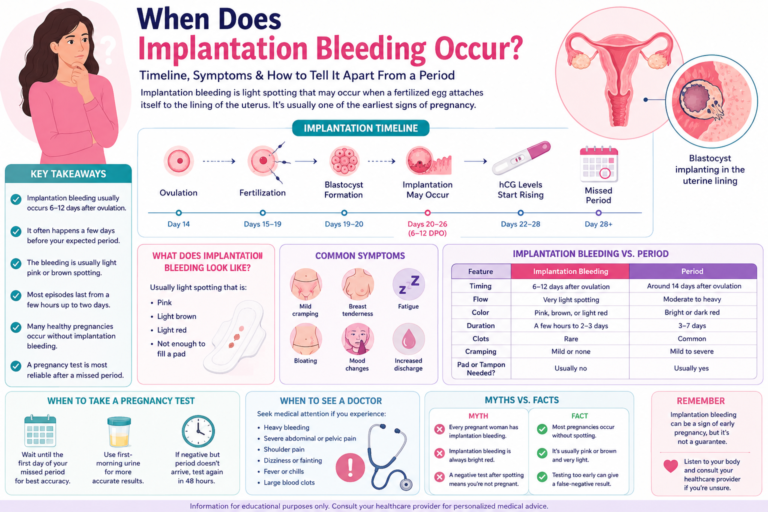
For someone with a typical 28-day menstrual cycle, the timeline often looks like this:
| Day | What Happens |
|---|---|
| Day 14 | Ovulation |
| Days 15–19 | Fertilization and embryo travels through the fallopian tube |
| Days 20–26 | Implantation usually occurs |
| Days 22–28 | Possible implantation spotting |
| Around Day 28 | Expected period or positive pregnancy test |
Keep in mind that every menstrual cycle is different. People with longer or shorter cycles may experience implantation earlier or later.
Implantation Timeline Explained
Understanding the journey from ovulation to pregnancy helps explain why implantation bleeding occurs when it does.
Days 0–1: Ovulation
An ovary releases a mature egg, which remains available for fertilization for approximately 24 hours.
Days 1–5: Fertilization
If sperm meets the egg inside the fallopian tube, fertilization occurs. The newly formed embryo immediately begins dividing into multiple cells.
Days 5–6: Blastocyst Formation
The embryo develops into a blastocyst and continues traveling toward the uterus.
Days 6–12: Implantation
The blastocyst attaches to the uterine lining. This is when implantation bleeding may occur.
Days 9–14: Rising hCG
After implantation, hCG levels begin increasing, although they may still be too low for some pregnancy tests to detect.
What Does Implantation Bleeding Look Like?
One of the easiest ways to identify implantation bleeding is by its appearance.
It is generally:
- Very light spotting
- Pink, light brown, or rust-colored
- Noticeable only when wiping or on underwear
- Not heavy enough to soak a sanitary pad
- Free of large blood clots
Some people experience spotting for only a few hours, while others notice light bleeding over one or two days.
Implantation Bleeding Color
The color can vary depending on how quickly the blood leaves the uterus.
Pink
Fresh blood mixed with cervical mucus.
Brown
Older blood that has taken longer to exit the body.
Light Red
Occasionally seen early during spotting but usually remains light.
Bright red, heavy bleeding is generally less typical of implantation and may indicate menstruation or another cause that deserves medical evaluation.
How Long Does Implantation Bleeding Last?
Implantation bleeding is usually brief.
Most people experience it for:
- A few hours
- One day
- Two days
Occasionally, spotting may continue for up to three days.
If bleeding becomes progressively heavier or lasts several days like a normal period, it is less likely to be implantation bleeding.
Common Symptoms of Implantation Bleeding
Besides spotting, some people notice mild early pregnancy symptoms around implantation.
These may include:
- Mild lower abdominal cramping
- Breast tenderness
- Fatigue
- Bloating
- Mood changes
- Increased cervical mucus
- Slight nausea (usually develops later)
- Elevated basal body temperature
Not everyone experiences these symptoms, and having them doesn’t necessarily confirm pregnancy.
Can Implantation Bleeding Occur Without Cramps?
Yes.
While some women only detect little spotting, others have minor cramps that resemble period cramps. Many people don’t have either.
Because each pregnancy is different, implantation symptoms differ greatly. Individual physiology, hormone levels, and genetics all affect how the body reacts in the early stages of pregnancy.
Implantation Bleeding vs. Period: How to Tell the Difference
One of the biggest reasons people search “when does implantation bleeding occur” is because they’re unsure whether the spotting they’re seeing is the start of their period or an early sign of pregnancy.
While the two can look similar at first, there are several differences that can help you tell them apart.
| Feature | Implantation Bleeding | Menstrual Period |
|---|---|---|
| Timing | 6–12 days after ovulation | Around 14 days after ovulation |
| Flow | Very light spotting | Moderate to heavy |
| Color | Pink, brown, or light red | Bright or dark red |
| Duration | A few hours to 2–3 days | 3–7 days |
| Clots | Rare | Common |
| Cramping | Mild or none | Mild to severe |
| Pad or Tampon Needed? | Usually no | Usually yes |
If your bleeding becomes heavier over time, includes large clots, or lasts several days, it’s more likely to be your menstrual period than implantation bleeding.
Can You Be Pregnant Without Implantation Bleeding?
Absolutely.
One of the biggest misconceptions is that every pregnancy includes implantation bleeding. In reality, many pregnant women never notice any spotting at all.
Several factors influence whether implantation bleeding occurs, including:
- How the embryo implants into the uterine lining
- The number of tiny blood vessels affected
- Individual hormonal differences
- Cervical sensitivity
So, if you’re trying to conceive and don’t experience spotting, don’t assume you’re not pregnant. Missing implantation bleeding is completely normal.
When Should You Take a Pregnancy Test?
Although implantation happens before your missed period, hCG (human chorionic gonadotropin) levels need time to rise.
For the most accurate result:
- Wait until the first day of your missed period.
- If the result is negative but your period still doesn’t arrive, test again 48 hours later.
- Use first-morning urine, which usually contains the highest concentration of hCG.
Testing too early can lead to a false-negative result because hormone levels may not yet be high enough to detect.
Can Implantation Bleeding Be Heavy?
Generally, no.
Implantation bleeding is usually light spotting. It should not soak through pads or tampons.
Heavy bleeding may be caused by:
- Menstruation
- Hormonal changes
- Early pregnancy loss
- Ectopic pregnancy
- Cervical conditions
- Other gynecological issues
If you’re pregnant and experience heavy bleeding, especially with severe pain, seek medical advice promptly.
When Should You Contact a Doctor?
Although light spotting in early pregnancy can be harmless, some symptoms require medical attention.
Contact your healthcare provider if you experience:
- Heavy bleeding similar to or heavier than a period
- Bright red bleeding that continues to increase
- Severe abdominal or pelvic pain
- Pain in one shoulder (possible ectopic pregnancy symptom)
- Fever or chills
- Dizziness or fainting
- Large blood clots
- Bleeding after a positive pregnancy test accompanied by significant cramping
Early evaluation can help identify conditions such as ectopic pregnancy, miscarriage, or infections that may need treatment.
Myths vs. Facts
| Myth | Fact |
|---|---|
| Every pregnant woman experiences implantation bleeding. | Most pregnancies occur without noticeable spotting. |
| Implantation bleeding is always bright red. | It’s more commonly pink or brown. |
| Heavy bleeding can still be implantation bleeding. | Implantation bleeding is usually very light. |
| Implantation bleeding guarantees pregnancy. | Spotting can have other causes; only a pregnancy test can confirm pregnancy. |
| A negative pregnancy test immediately after spotting means you’re not pregnant. | Testing too early may produce a false-negative result. |
Frequently Asked Questions
Does implantation bleeding always mean you’re pregnant?
Implantation bleeding can be an early sign of pregnancy, but not all spotting is related to implantation. A pregnancy test is the best way to confirm pregnancy.
Can implantation bleeding happen after a missed period?
It’s uncommon. Implantation usually occurs before your expected period. Bleeding after a missed period may have another cause and should be discussed with a healthcare provider if you’re unsure.
What color is implantation bleeding?
It is most often light pink or brown, although some people notice light red spotting.
Can implantation bleeding include clots?
Large clots are uncommon with implantation bleeding. If you notice heavy bleeding with clots, it is more likely to be a menstrual period or another condition.
How long after implantation does a pregnancy test become positive?
Many home pregnancy tests can detect hCG about 2–4 days after implantation, but the most reliable results are usually obtained after a missed period.
Can implantation bleeding happen more than once?
Implantation itself happens only once during a pregnancy. However, some women may notice intermittent light spotting over a short period, which can make it seem as though it occurred multiple times.
Final Thoughts
If you’re wondering when does implantation bleeding occur, the answer is usually between 6 and 12 days after ovulation, often a few days before your expected period. When it does occur, it’s typically light, short-lived, and pink or brown rather than heavy and bright red.
However, implantation bleeding isn’t a reliable way to confirm pregnancy because many healthy pregnancies happen without any spotting at all. The most dependable way to know if you’re pregnant is to take a home pregnancy test after you’ve missed your period or consult your healthcare provider for further evaluation.
Understanding the timing, appearance, and symptoms of implantation bleeding can help reduce uncertainty and make it easier to distinguish normal early pregnancy changes from menstrual bleeding or conditions that require medical attention.
