

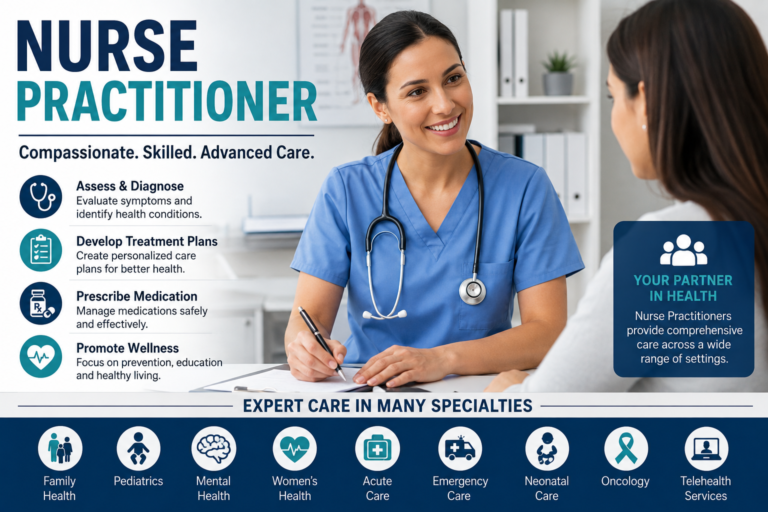
If you have ever wondered whether a nurse practitioner is the same as a doctor, what an NP can actually do, or how much education is required to become one, you are not alone. Nurse practitioners have become an important part of modern healthcare, providing everything from routine checkups and preventive care to diagnosis and treatment of many health conditions.
A nurse practitioner (NP) is an advanced practice registered nurse (APRN) with specialized education and clinical training. Depending on their specialty and local regulations, NPs may assess patients, diagnose illnesses, order tests, prescribe medications, and manage both acute and chronic conditions.
This guide explains what nurse practitioners do, the different types of NPs, how to become one, salary considerations, scope of practice, and how NPs compare with physicians and registered nurses.
What Is a Nurse Practitioner?
A nurse practitioner is a licensed healthcare professional who has completed advanced nursing education and clinical training beyond the level required to become a registered nurse (RN).
Nurse practitioners combine nursing knowledge with advanced clinical skills. Their work can include:
- Taking medical histories
- Performing physical examinations
- Assessing symptoms
- Diagnosing certain medical conditions
- Ordering and interpreting diagnostic tests
- Developing treatment plans
- Prescribing medications when authorized
- Managing chronic diseases
- Providing preventive healthcare
- Educating patients about their health
- Referring patients to specialists when necessary
Unlike an RN, an NP can perform many functions traditionally associated with medical providers. However, the exact authority of an NP depends on their specialty, credentials, and the laws where they practice.
What Does a Nurse Practitioner Do?
The day-to-day responsibilities of an NP vary considerably depending on the specialty and workplace.
For example, a family nurse practitioner (FNP) may see patients for annual physicals, infections, diabetes, hypertension, minor injuries, and preventive care. A psychiatric-mental health nurse practitioner (PMHNP) may evaluate mental health conditions and provide medication management and other psychiatric services.
In general, an NP focuses on the whole patient rather than simply treating an individual symptom. Patient education, prevention, lifestyle counseling, and long-term disease management are often important parts of the job.
Where Do Nurse Practitioners Work?
Nurse practitioners can work in many healthcare environments, including:
- Primary care clinics
- Hospitals
- Urgent care centers
- Private practices
- Community health centers
- Specialty clinics
- Mental health facilities
- Women’s health centers
- Long-term care settings
- Telehealth services
- Academic and healthcare institutions
Their work environment usually reflects their specialty and patient population.
What Can a Nurse Practitioner Do?
One reason people search for information about NPs is that their responsibilities can overlap with those of physicians.
Can Nurse Practitioners Diagnose Patients?
In jurisdictions where their scope of practice permits it, nurse practitioners can assess patients, identify illnesses and health conditions, and make diagnoses within their professional scope.
The diagnostic process may include reviewing medical history, performing a physical examination, evaluating symptoms, and ordering laboratory or imaging tests.
Can Nurse Practitioners Prescribe Medication?
Many nurse practitioners have prescribing authority, but the specific rules differ depending on the jurisdiction, specialty, and type of medication.
Some jurisdictions allow NPs broad prescribing authority, while others require varying levels of physician collaboration or supervision.
Can Nurse Practitioners Order Tests?
Yes, NPs may order or arrange diagnostic testing as permitted by their scope of practice. Depending on the clinical situation, this can include blood tests, urine tests, imaging studies, or other diagnostic procedures.
Can NPs Refer Patients to Specialists?
Yes. When a patient’s condition requires specialized evaluation or treatment, an NP can refer the patient to an appropriate specialist according to the rules and systems of their practice.
Can Nurse Practitioners Provide Primary Care?
Absolutely. Primary care is one of the most common areas of NP practice.
Primary care NPs may provide:
- Routine physical examinations
- Preventive screenings
- Vaccinations
- Health counseling
- Treatment for common illnesses
- Chronic disease management
- Medication management
- Follow-up care
Types of Nurse Practitioners
“Nurse practitioner” is an umbrella term. NPs can specialize in different patient populations and areas of healthcare.
Family Nurse Practitioner (FNP)
A family nurse practitioner provides care to patients across much of the lifespan, depending on their training and practice setting.
FNPs commonly work in primary care and may treat:
- Respiratory infections
- High blood pressure
- Diabetes
- Minor injuries
- Skin conditions
- Routine women’s and men’s health concerns
- Common acute illnesses
They also provide preventive care and health education.
Adult-Gerontology Nurse Practitioner
Adult-gerontology NPs focus on the healthcare needs of adolescents, adults, and older adults, depending on their specific certification.
They may work in primary care or acute care environments and often manage chronic diseases that become more common with age.
Pediatric Nurse Practitioner (PNP)
Pediatric nurse practitioners specialize in healthcare for children and adolescents.
Their work can include:
- Well-child visits
- Growth and development monitoring
- Immunizations
- Childhood illnesses
- Preventive care
- Parent education
Psychiatric-Mental Health Nurse Practitioner (PMHNP)
A psychiatric-mental health nurse practitioner specializes in mental and behavioral healthcare.
Depending on local regulations and credentials, PMHNPs may evaluate and manage conditions such as:
- Depression
- Anxiety disorders
- ADHD
- Bipolar disorder
- Other psychiatric conditions
Their services may include psychiatric assessment, medication management, psychotherapy, or other behavioral health interventions within their scope.
Acute Care Nurse Practitioner (ACNP)
Acute care NPs generally care for patients with complex, serious, or rapidly changing medical conditions.
They may work in:
- Hospitals
- Intensive care settings
- Specialty units
- Emergency-related environments
- Inpatient services
Women’s Health Nurse Practitioner (WHNP)
Women’s health NPs focus on reproductive and gynecologic healthcare, preventive services, and other women’s health needs within their training and scope.
Neonatal Nurse Practitioner (NNP)
Neonatal nurse practitioners care for newborns, particularly infants who require specialized or intensive medical attention.
Nurse Practitioner vs Doctor
One of the most common questions is whether an NP is a doctor.
The short answer is no—not in the medical sense of being a physician.
A nurse practitioner follows an advanced nursing pathway, while a physician follows a medical education pathway.
| Area | Nurse Practitioner | Physician |
|---|---|---|
| Professional pathway | Advanced nursing | Medical education |
| Initial nursing/medical training | Nursing pathway | Medical school |
| Advanced degree | MSN or DNP may be used | MD or DO |
| Patient assessment | Yes | Yes |
| Diagnosis | Within scope | Yes |
| Treatment | Within scope | Yes |
| Prescribing | Depending on jurisdiction | Yes |
| Specialization | NP specialty | Medical specialty |
| Practice authority | Varies by jurisdiction | Generally broader |
Is a Nurse Practitioner a Doctor?
A nurse practitioner can hold a Doctor of Nursing Practice (DNP) degree, which is a doctoral-level nursing degree. However, a DNP is not the same professional degree as an MD or DO.
The important distinction is between degree level and professional role.
A DNP-prepared nurse practitioner is a doctorally educated nurse practitioner, but that does not make them a medical doctor.
When Should You See an NP Instead of a Doctor?
For many routine healthcare needs, a qualified NP can be an appropriate healthcare provider.
You might see an NP for:
- Routine checkups
- Preventive care
- Common illnesses
- Chronic disease management
- Medication follow-up
- Health counseling
- Some specialized services
More complex cases may require collaboration with or referral to a physician or another specialist.
Nurse Practitioner vs Registered Nurse
Although both professionals are nurses, an NP and an RN have different levels of education, training, and clinical responsibility.
A registered nurse primarily provides nursing care, monitors patients, administers medications, assists with treatment, and supports patients and families.
A nurse practitioner has advanced clinical education and can perform additional functions such as diagnosing conditions and developing treatment plans, depending on applicable regulations.
Key Differences Between an RN and NP
RN:
- Provides nursing care
- Monitors patients
- Administers medications
- Educates patients
- Supports treatment plans
- Works under the scope of an RN license
NP:
- Performs advanced patient assessments
- Can diagnose within their scope
- May prescribe medications
- Develops treatment plans
- Manages chronic conditions
- May provide primary or specialty care
Can an RN Become a Nurse Practitioner?
Yes. Becoming an NP generally requires additional education and clinical preparation beyond RN licensure.
Many aspiring NPs first complete a nursing degree, obtain RN licensure, gain clinical experience, and then pursue graduate-level NP education.
How to Become a Nurse Practitioner
The exact pathway varies by educational program and jurisdiction, but the general process looks like this:
Step 1: Become a Registered Nurse
The first stage is usually completing an approved nursing education pathway and obtaining RN licensure.
Step 2: Complete Advanced Nursing Education
Aspiring NPs generally pursue graduate-level nursing education, such as:
- Master of Science in Nursing (MSN)
- Doctor of Nursing Practice (DNP)
The program should prepare the student for their intended NP population focus or specialty.
Step 3: Complete Clinical Training
NP programs include supervised clinical education. This allows students to develop practical skills in assessment, diagnosis, treatment planning, patient education, and disease management.
Step 4: Choose an NP Specialty
Students select a population focus or specialty, such as family practice, pediatrics, adult-gerontology, psychiatric mental health, or acute care.
Step 5: Obtain National Certification
Depending on the specialty and jurisdiction, graduates may need to pass an appropriate national certification examination.
Step 6: Obtain Licensure
After meeting educational and certification requirements, the nurse practitioner applies for the appropriate professional license or authorization to practice.
Step 7: Maintain Credentials
NPs generally need to meet continuing education, certification renewal, and other professional requirements throughout their careers.
Nurse Practitioner Education Requirements
Becoming a nurse practitioner requires significantly more education than becoming an RN.
What Degree Does a Nurse Practitioner Need?
Common advanced degrees include:
MSN:
A Master of Science in Nursing is a graduate-level nursing degree and has traditionally been a common route into advanced practice nursing.
DNP:
The Doctor of Nursing Practice is a practice-focused doctoral degree designed for advanced nursing practice and leadership.
The exact educational requirements can change based on specialty, jurisdiction, and professional regulations.
How Long Does It Take to Become an NP?
There is no single timeline that applies to everyone.
The total time depends on:
- Previous nursing education
- RN status
- Degree pathway
- NP specialty
- Full-time or part-time study
- Clinical requirements
- Certification and licensing requirements
Someone entering nursing from the beginning will generally need considerably longer than an experienced RN who already has the required educational foundation.
Nurse Practitioner Salary
NP compensation varies widely, so there isn’t one salary figure that applies to every nurse practitioner.
Factors affecting earnings include:
- Specialty
- Geographic location
- Years of experience
- Work setting
- Education
- Employer
- Full-time or part-time status
- Additional responsibilities
How Much Does a Nurse Practitioner Make?
Nurse practitioners can earn competitive salaries compared with many other healthcare occupations. However, salary data should always be interpreted in context because national averages can hide significant differences between states, cities, specialties, and experience levels.
Highest-Paying Nurse Practitioner Specialties
Some specialized NP roles may command higher compensation because of factors such as complexity of care, demand, clinical environment, and specialized skills.
Potentially higher-paying areas may include certain:
- Acute care positions
- Psychiatric mental health roles
- Emergency care positions
- Specialty practice roles
- Hospital-based positions
Salary alone shouldn’t be the only factor when choosing an NP specialty.
Nurse Practitioner Scope of Practice
Scope of practice describes the services and responsibilities a healthcare professional is legally authorized to perform.
For NPs, scope of practice is particularly important because it can differ between jurisdictions.
Full Practice Authority
In a full-practice model, NPs may have authority to evaluate patients, diagnose conditions, order and interpret tests, initiate treatment, and prescribe medications without mandatory physician supervision, subject to applicable laws.
Reduced Practice
Some jurisdictions require an NP to have a formal collaborative relationship with a physician for certain aspects of practice.
Restricted Practice
In more restrictive systems, physician supervision or collaboration may be required for a broader range of NP activities.
Can an NP Practice Independently?
Sometimes. Whether an NP can practice independently depends on the jurisdiction, specialty, credentials, and applicable regulations.
This is why a statement about what all nurse practitioners can or cannot do can be misleading.
Nurse Practitioner Specialties and Career Options
Choosing an NP specialty is an important career decision.
Some nurses prioritize salary, while others care more about patient population, schedule, clinical environment, or work-life balance.
Primary Care NP
Ideal for professionals interested in long-term patient relationships, preventive medicine, and chronic disease management.
Mental Health NP
A growing area for nurses interested in psychiatric assessment, behavioral health, and mental healthcare.
Pediatric NP
Suitable for those who enjoy working with children and families.
Acute Care NP
A good fit for nurses who prefer complex medical cases and hospital-based care.
Women’s Health NP
Focuses on specialized healthcare needs of women across different stages of life.
Which NP Specialty Is Best?
There is no universally “best” specialty. The right option depends on your:
- Career goals
- Interests
- Preferred patient population
- Desired work environment
- Income expectations
- Lifestyle preferences
- Long-term professional plans
Where Do Nurse Practitioners Work?
NPs have flexible career options and can work in a variety of settings.
Hospitals
Hospital-based NPs may care for patients with complex or acute conditions.
Primary Care Clinics
Primary care remains one of the most common environments for NPs.
Urgent Care
NPs may evaluate and treat patients with relatively immediate but non-emergency health concerns.
Private Practices
Some NPs work within physician practices or other private healthcare organizations.
Community Health Centers
These settings may provide healthcare to underserved populations and communities.
Telehealth
Telehealth has created additional opportunities for some NPs to provide remote consultations and follow-up care, subject to applicable regulations.
Benefits and Challenges of Being a Nurse Practitioner
Advantages of Becoming an NP
Some major benefits include:
- Greater clinical responsibility
- Multiple specialty options
- Strong demand for advanced healthcare professionals
- Opportunities for primary and specialty care
- Meaningful patient relationships
- Potential for competitive compensation
- Opportunities in hospitals, clinics, and telehealth
Challenges of Being an NP
The career also comes with significant responsibilities.
These may include:
- Extensive education and training
- Certification requirements
- Continuing education
- Complex clinical decisions
- Emotional demands of patient care
- Licensing restrictions
- Different scope-of-practice rules
- High workloads in some healthcare settings
Being an NP can be rewarding, but it requires a commitment to lifelong learning and professional development.
Nurse Practitioner Career Outlook
The healthcare system increasingly relies on advanced practice nurses to help meet patient needs.
Several factors contribute to demand for nurse practitioners, including:
- Aging populations
- Increasing chronic disease
- Shortages of healthcare professionals in some areas
- Growing demand for primary care
- Increased need for mental healthcare
- Expansion of outpatient healthcare
- Growth of telehealth
Career opportunities can vary by location and specialty, so prospective NPs should research current employment trends in the area where they plan to practice.
Frequently Asked Questions About Nurse Practitioners
What exactly does a nurse practitioner do?
A nurse practitioner provides advanced patient care that can include assessment, diagnosis, treatment, preventive care, chronic disease management, patient education, and medication management within their legal scope of practice.
Is a nurse practitioner the same as a doctor?
No. An NP is an advanced practice nurse, while a physician is a medical doctor. However, NPs can provide many healthcare services that overlap with physician services.
Can a nurse practitioner prescribe medication?
In many jurisdictions, NPs can prescribe medications, although prescribing authority and restrictions vary according to local law and the medication involved.
Can an NP diagnose medical conditions?
Yes, NPs can diagnose conditions within their authorized scope of practice.
Can a nurse practitioner work independently?
In some jurisdictions, NPs have full practice authority. In others, collaboration or supervision requirements apply.
How many years does it take to become an NP?
The timeline depends on your starting education, nursing experience, degree pathway, specialty, clinical requirements, and licensing process.
How much does a nurse practitioner make?
NP salaries vary according to specialty, location, experience, employer, and work setting. Current local salary data is more useful than relying on a single national figure.
What is the highest-paying NP specialty?
Compensation varies by location and employer, but some acute-care, psychiatric, emergency, and highly specialized NP roles can offer strong earning potential.
Is an NP higher than an RN?
An NP has advanced education, certification, and clinical responsibilities beyond those of a traditional RN. They are different professional roles rather than simply different ranks of the same job.
What is the difference between an NP and an APRN?
APRN is a broader category of advanced practice registered nurses. Nurse practitioners are one type of APRN, alongside roles such as nurse-midwives, nurse anesthetists, and clinical nurse specialists.
