

Introduction
A heart attack is one of the most time-sensitive medical emergencies, but not all heart attacks are the same. Among the different types, ST-Elevation Myocardial Infarction (STEMI) is considered the most severe because it usually occurs when a coronary artery becomes completely blocked, cutting off blood supply to part of the heart muscle. Without immediate treatment, permanent heart damage—or even death—can occur within hours.
The good news is that modern treatments such as Primary Percutaneous Coronary Intervention (Primary PCI) and thrombolytic therapy have dramatically improved survival rates when performed quickly. Recognizing the warning signs and seeking emergency medical care immediately can save heart muscle and lives.
This comprehensive guide explains what STEMI is, its symptoms, causes, ECG findings, diagnosis, treatment options, recovery process, and ways to reduce your future risk.
What Is STEMI?
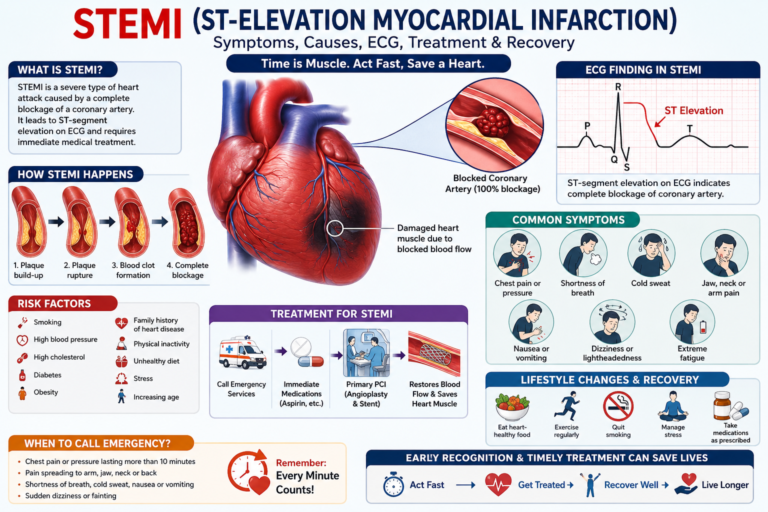
STEMI (ST-Elevation Myocardial Infarction) is a severe type of acute myocardial infarction (heart attack) caused by the sudden and complete blockage of a coronary artery. The blockage prevents oxygen-rich blood from reaching a portion of the heart muscle (myocardium), causing rapid tissue damage.
The condition gets its name from a characteristic pattern called ST-segment elevation seen on an electrocardiogram (ECG). This ECG finding indicates significant injury to the heart muscle and signals the need for immediate treatment.
Unlike less severe forms of heart attack, STEMI requires urgent restoration of blood flow to minimize permanent damage.
What Does STEMI Stand For?
- ST = ST segment on an ECG
- Elevation = The ST segment appears abnormally elevated
- Myocardial = Heart muscle
- Infarction = Death of tissue due to lack of blood supply
Simply put, STEMI means that part of the heart muscle is being seriously damaged because blood flow has stopped.
Why Is STEMI a Medical Emergency?
Heart muscle begins to die within minutes after blood flow is blocked.
Doctors often use the phrase:
“Time is muscle.”
The longer treatment is delayed, the more heart muscle is permanently damaged. This increases the risk of:
- Heart failure
- Dangerous heart rhythm abnormalities (arrhythmias)
- Cardiogenic shock
- Sudden cardiac arrest
- Death
Rapid diagnosis and treatment significantly improve survival and long-term heart function.
How Does a STEMI Happen?
Understanding how STEMI develops can help explain why emergency treatment is so critical.
Step 1: Atherosclerosis Develops
Over many years, fatty deposits called atherosclerotic plaques build up inside the coronary arteries.
These plaques contain:
- Cholesterol
- Fat
- Calcium
- Inflammatory cells
- Fibrous tissue
As plaques grow, they gradually narrow the arteries supplying blood to the heart.
Step 2: Plaque Rupture
Sometimes a plaque suddenly ruptures.
When this happens, the body mistakenly treats it like an injury and activates the blood-clotting system.
Step 3: Blood Clot Forms
Platelets rapidly gather at the rupture site, forming a clot (coronary thrombosis).
In STEMI, this clot completely blocks the coronary artery.
No oxygen-rich blood reaches the downstream heart muscle.
Step 4: Heart Muscle Damage Begins
Without oxygen, heart muscle cells begin to die.
The longer the blockage remains untreated, the greater the damage.
If blood flow is restored quickly, much of the heart muscle can often be saved.
STEMI Symptoms
Symptoms usually begin suddenly and should never be ignored.
Although chest pain is the most common symptom, not everyone experiences the same warning signs.
Classic Symptoms
Most patients experience:
- Severe chest pain or pressure
- Crushing or squeezing sensation
- Pain lasting longer than 20 minutes
- Pain spreading to the left arm
- Pain radiating to the jaw
- Shoulder pain
- Neck pain
- Upper back pain
Many people describe it as “an elephant sitting on the chest.”
Other Common Symptoms
Additional symptoms include:
- Shortness of breath
- Cold sweating
- Nausea
- Vomiting
- Dizziness
- Lightheadedness
- Extreme fatigue
- Anxiety
- Rapid heartbeat
- Feeling faint
Symptoms in Women
Women may have less obvious symptoms than men.
Instead of severe chest pain, they may experience:
- Shortness of breath
- Unusual fatigue
- Indigestion-like discomfort
- Upper back pain
- Jaw pain
- Nausea
- Vomiting
- Dizziness
Because these symptoms are sometimes mistaken for less serious conditions, women may delay seeking treatment.
Symptoms in Older Adults
Older adults may experience:
- Weakness
- Confusion
- Dizziness
- Fainting
- Difficulty breathing
- Mild chest discomfort
Symptoms in People with Diabetes
People with diabetes are more likely to have a silent STEMI, meaning chest pain is mild or absent.
Instead, they may notice:
- Sudden fatigue
- Sweating
- Shortness of breath
- Nausea
- Weakness
- Lightheadedness
This is why regular cardiovascular checkups are especially important for people with diabetes.
When Should You Call Emergency Services?
Call emergency medical services immediately if you have:
- Chest pain lasting more than 10–15 minutes
- Pain spreading to the arm, jaw, neck, or back
- Difficulty breathing
- Cold sweat
- Sudden collapse
- Loss of consciousness
Do not drive yourself to the hospital unless no other option is available. Emergency medical teams can begin life-saving treatment before you arrive.
Causes of STEMI
The underlying cause of most STEMIs is Coronary Artery Disease (CAD).
However, several conditions can trigger complete blockage of a coronary artery.
Atherosclerosis
The most common cause is plaque buildup inside the coronary arteries.
Over time, plaques narrow the arteries and reduce blood flow.
Plaque Rupture
When a plaque breaks open, platelets rapidly form a clot.
A complete blockage leads to STEMI.
Coronary Artery Spasm
Occasionally, a severe coronary artery spasm temporarily blocks blood flow.
Although less common, this can also trigger STEMI.
Spontaneous Coronary Artery Dissection (SCAD)
SCAD occurs when a tear develops within the coronary artery wall.
It is more common in younger women and may occur during or shortly after pregnancy.
Drug-Induced Coronary Blockage
Certain recreational drugs, particularly cocaine and amphetamines, can cause severe artery spasms and increase the risk of STEMI.
Risk Factors
Several factors increase the likelihood of developing STEMI.
Non-Modifiable Risk Factors
- Increasing age
- Male sex
- Family history of heart disease
- Genetic predisposition
Modifiable Risk Factors
Many risk factors can be controlled through lifestyle changes and medical care.
These include:
- Smoking
- High blood pressure (hypertension)
- High cholesterol
- Diabetes
- Obesity
- Physical inactivity
- Poor diet
- Excessive alcohol intake
- Chronic stress
- Sleep apnea
Managing these conditions significantly lowers the risk of future heart attacks.
STEMI vs NSTEMI vs Unstable Angina
Although all three conditions fall under Acute Coronary Syndrome (ACS), they differ in severity and treatment urgency.
| Feature | STEMI | NSTEMI | Unstable Angina |
|---|---|---|---|
| Artery blockage | Complete | Partial | Temporary reduction |
| ECG | ST-segment elevation | No ST elevation | Usually normal or minor changes |
| Troponin | Elevated | Elevated | Usually normal |
| Heart muscle damage | Severe | Moderate | None or minimal |
| Emergency PCI | Immediate | Often required | Depends on risk |
Among these conditions, STEMI is the most urgent because complete blockage causes rapid and extensive heart muscle injury.
STEMI ECG Findings
An Electrocardiogram (ECG) is the fastest and most important test for diagnosing STEMI.
Typical ECG Features
Doctors look for several characteristic findings, including:
- ST-segment elevation
- Reciprocal ST depression
- Hyperacute T waves
- Pathological Q waves (later)
- New left bundle branch block in selected cases
STEMI Locations on ECG
The ECG can also indicate which part of the heart is affected.
| STEMI Type | Coronary Artery Usually Involved | ECG Leads |
|---|---|---|
| Anterior STEMI | Left Anterior Descending (LAD) | V1–V4 |
| Inferior STEMI | Right Coronary Artery (RCA) | II, III, aVF |
| Lateral STEMI | Left Circumflex (LCx) | I, aVL, V5–V6 |
| Posterior STEMI | RCA or LCx | V7–V9 (or reciprocal changes) |
Identifying the location helps cardiologists plan the most effective treatment.
How Is STEMI Diagnosed?
Doctors work quickly because every minute counts.
Diagnosis usually involves a combination of clinical evaluation and specialized tests.
Medical History and Physical Examination
Your healthcare provider will ask about:
- Chest pain characteristics
- Symptom onset
- Previous heart disease
- Risk factors
- Family history
A physical examination may reveal abnormal heart sounds, low blood pressure, or signs of heart failure.
Electrocardiogram (ECG)
A 12-lead ECG is performed immediately. It is the cornerstone of STEMI diagnosis because it can detect ST-segment elevation within minutes of symptom onset.
Cardiac Troponin Test
Troponin is a protein released into the bloodstream when heart muscle cells are damaged. Elevated troponin levels strongly support the diagnosis of myocardial infarction.
Blood Tests
Additional blood tests may include:
- Complete blood count (CBC)
- Electrolytes
- Kidney function tests
- Blood glucose
- Lipid profile
- CK-MB (in selected cases)
Echocardiogram
An echocardiogram uses ultrasound to assess heart function, identify damaged areas, and detect complications such as reduced pumping ability or valve problems.
Coronary Angiography (Gold Standard)
Coronary angiography is considered the gold standard for identifying the blocked artery. A contrast dye is injected into the coronary arteries, allowing cardiologists to locate the blockage and often treat it immediately with Primary Percutaneous Coronary Intervention (PCI) and coronary stent placement.
Emergency Treatment for STEMI
When a STEMI occurs, every minute counts. The primary goal is to restore blood flow to the blocked coronary artery as quickly as possible. Early treatment reduces heart muscle damage, lowers the risk of complications, and improves survival.
Call Emergency Medical Services Immediately
If you or someone nearby experiences symptoms of a heart attack:
- Call your local emergency number immediately.
- Do not ignore symptoms or wait to see if they improve.
- Avoid driving yourself to the hospital unless there is no alternative.
- Emergency medical personnel can begin treatment before you reach the hospital.
Aspirin
If advised by emergency services and there is no allergy or contraindication, chewing an aspirin may help reduce blood clot formation while waiting for medical care.
Oxygen Therapy
Oxygen is not routinely given to every patient. It is typically used when oxygen levels are low or if there is significant difficulty breathing.
Nitroglycerin
Nitroglycerin may relieve chest pain by improving blood flow to the heart. However, it should only be taken under medical guidance because it is not safe for everyone, particularly people with very low blood pressure or those who have recently taken certain medications for erectile dysfunction.
Hospital Treatment for STEMI
Once at the hospital, doctors act quickly to reopen the blocked artery.
Primary Percutaneous Coronary Intervention (Primary PCI)
Primary PCI is considered the preferred treatment for most patients with STEMI when it can be performed promptly.
During the procedure:
- A thin catheter is inserted through an artery in the wrist or groin.
- It is guided to the blocked coronary artery.
- A small balloon inflates to open the blockage.
- A coronary stent is placed to keep the artery open.
Primary PCI restores blood flow more effectively than clot-dissolving medication in many cases and lowers the risk of recurrent heart attacks.
Balloon Angioplasty
Balloon angioplasty is part of the PCI procedure. The balloon compresses the plaque against the artery wall, allowing blood to flow more freely before the stent is implanted.
Coronary Stent Placement
A coronary stent is a tiny mesh tube that supports the artery after angioplasty.
Modern drug-eluting stents (DES) slowly release medication that helps prevent the artery from narrowing again.
Thrombolytic Therapy
If Primary PCI is not immediately available, doctors may use thrombolytic (clot-busting) medications to dissolve the blood clot.
These medications work best when administered within the first few hours after symptoms begin.
Coronary Artery Bypass Grafting (CABG)
CABG surgery may be recommended if:
- Multiple coronary arteries are severely blocked.
- PCI cannot successfully restore blood flow.
- The anatomy is unsuitable for stenting.
- Serious complications are present.
During CABG, surgeons use healthy blood vessels from another part of the body to bypass blocked coronary arteries.
Medications After STEMI
Most patients continue medications long after leaving the hospital to reduce the risk of another heart attack.
| Medication | Purpose |
|---|---|
| Aspirin | Prevents blood clots |
| Clopidogrel or Ticagrelor | Keeps platelets from sticking together |
| Statins | Lower cholesterol and stabilize plaque |
| Beta Blockers | Reduce the heart’s workload |
| ACE Inhibitors or ARBs | Protect heart function and control blood pressure |
| Anticoagulants (when indicated) | Reduce clot formation in selected patients |
| Nitrates | Help relieve chest pain in some patients |
Always take medications exactly as prescribed and never stop them without consulting your healthcare provider.
Recovery After STEMI
Recovery depends on:
- How quickly treatment was received.
- The amount of heart muscle damaged.
- Overall health.
- Participation in cardiac rehabilitation.
Hospital Stay
Most uncomplicated cases remain in the hospital for several days, although the exact duration varies depending on individual circumstances.
Recovery Timeline
First Week
- Rest and gentle walking.
- Medication adjustment.
- Follow-up appointments.
Weeks 2–6
- Energy gradually improves.
- Light household activities become easier.
- Cardiac rehabilitation often begins.
2–3 Months
- Most patients return to office work if approved by their doctor.
- Walking and other low-impact exercises increase gradually.
3–6 Months
- Many people resume most normal daily activities.
- Ongoing lifestyle changes remain essential for long-term heart health.
Cardiac Rehabilitation
Cardiac rehabilitation is one of the most effective ways to recover after STEMI.
It typically includes:
- Supervised exercise training.
- Heart-healthy nutrition counseling.
- Medication education.
- Stress management techniques.
- Smoking cessation support.
- Risk factor management.
Patients who complete cardiac rehabilitation often experience better quality of life and a lower risk of future cardiac events.
Lifestyle Changes After STEMI
Long-term recovery depends on healthy habits as much as medical treatment.
Eat a Heart-Healthy Diet
Choose foods such as:
- Fruits and vegetables
- Whole grains
- Beans and legumes
- Fish rich in omega-3 fatty acids
- Lean poultry
- Nuts and seeds
- Olive oil
Limit:
- Processed foods
- Sugary drinks
- Excess sodium
- Saturated fats
- Trans fats
Exercise Regularly
Physical activity should increase gradually under medical supervision.
Recommended activities include:
- Walking
- Cycling
- Swimming
- Light strength training (when approved)
Stop Smoking
Smoking damages blood vessels, accelerates atherosclerosis, and significantly increases the risk of another heart attack.
Quitting smoking is one of the most important steps toward better cardiovascular health.
Control Blood Pressure, Cholesterol, and Diabetes
Keeping these conditions well managed greatly reduces the chance of another STEMI.
Regular medical follow-up and medication adherence are essential.
Manage Stress
Chronic stress may negatively affect heart health.
Helpful techniques include:
- Meditation
- Deep breathing exercises
- Yoga
- Adequate sleep
- Counseling when needed
Possible Complications
Even with prompt treatment, complications may occur.
Heart Failure
Large heart attacks may weaken the heart’s pumping ability.
Arrhythmias
Abnormal heart rhythms can develop during or after STEMI.
Cardiogenic Shock
The damaged heart may become unable to pump enough blood to meet the body’s needs.
Cardiac Arrest
Severe electrical disturbances may cause the heart to stop beating effectively.
Ventricular Fibrillation
This life-threatening rhythm requires immediate defibrillation.
Recurrent Heart Attack
People who have experienced one STEMI remain at increased risk for future cardiac events if risk factors are not controlled.
Can STEMI Be Prevented?
Although not every heart attack can be prevented, many risk factors are modifiable.
Helpful preventive measures include:
- Avoid tobacco use.
- Maintain a healthy weight.
- Exercise regularly.
- Follow a balanced diet.
- Control blood pressure.
- Manage diabetes effectively.
- Lower high cholesterol.
- Limit alcohol intake.
- Attend routine health checkups.
- Take prescribed medications consistently.
Prognosis
The outlook after STEMI has improved dramatically due to advances in emergency cardiac care.
Patients who receive rapid Primary PCI, take medications as directed, complete cardiac rehabilitation, and adopt healthy lifestyle habits often recover well and enjoy a good quality of life.
However, delayed treatment increases the likelihood of permanent heart damage and long-term complications.
Frequently Asked Questions
Is STEMI the most serious type of heart attack?
Yes. STEMI usually involves complete blockage of a coronary artery and requires immediate treatment.
Can someone survive a STEMI?
Yes. Survival rates have improved significantly with rapid diagnosis and timely treatment, especially Primary PCI.
What is the difference between STEMI and NSTEMI?
STEMI involves complete blockage of a coronary artery and shows ST-segment elevation on ECG, while NSTEMI usually results from partial blockage without ST-segment elevation.
Can STEMI occur without chest pain?
Yes. Women, older adults, and people with diabetes may have atypical or “silent” symptoms.
How long does recovery take?
Many patients recover over several weeks to months, although recovery varies depending on the extent of heart damage and overall health.
Can I exercise after STEMI?
Yes. Exercise is encouraged as part of cardiac rehabilitation, but it should be started gradually under medical supervision.
Will I need lifelong medication?
Many patients require long-term medications to reduce the risk of future heart attacks. Your healthcare provider will determine the best treatment plan for your situation.
Can another STEMI happen?
Yes. The risk is higher without healthy lifestyle changes, medication adherence, and regular follow-up care.
Key Takeaways
- STEMI is the most severe form of heart attack caused by complete blockage of a coronary artery.
- Early recognition of symptoms and rapid medical treatment can save heart muscle and lives.
- Primary PCI is the preferred treatment whenever available.
- Recovery includes medications, cardiac rehabilitation, and long-term lifestyle changes.
- Managing blood pressure, cholesterol, diabetes, and smoking cessation significantly lowers the risk of another heart attack.
Conclusion
A STEMI is a life-threatening emergency that demands immediate medical attention. Understanding the warning signs, seeking emergency care without delay, and receiving prompt treatment can dramatically improve survival and reduce permanent heart damage.
Modern therapies such as Primary PCI, coronary stenting, evidence-based medications, and cardiac rehabilitation have transformed outcomes for many patients. By combining medical treatment with healthy lifestyle habits, many people can recover successfully and reduce the risk of future cardiac events.
