

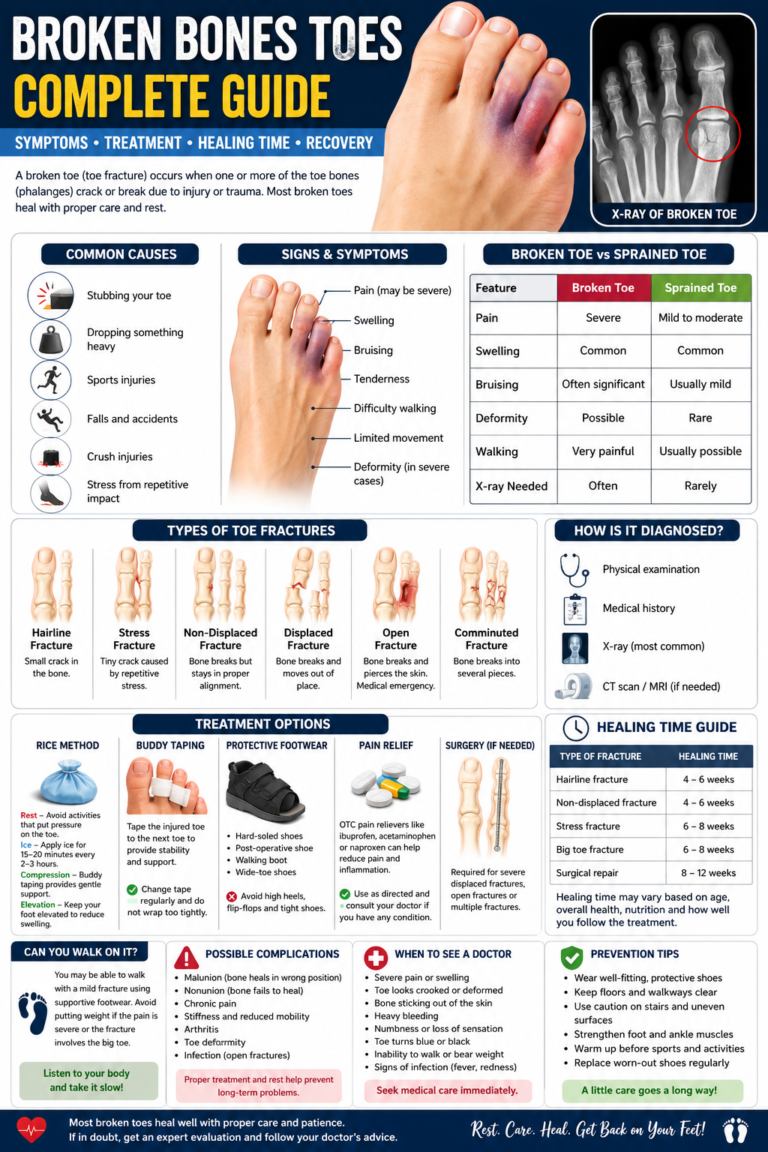
A broken toe may seem like a minor injury, but it can make every step painful and interfere with your daily activities. Whether you stubbed your toe against furniture, dropped a heavy object on your foot, or suffered a sports injury, a fractured toe should never be ignored. While many toe fractures heal with simple home care, some require medical treatment to prevent long-term complications such as chronic pain, stiffness, or improper bone healing.
Your toes contain small but essential bones called phalanges, which help maintain balance, support body weight, and provide stability while walking or running. Because these bones absorb significant pressure with every step, they’re vulnerable to fractures from direct impact or repetitive stress.
In this guide, you’ll learn how to recognize the symptoms of a broken toe, understand the different types of fractures, compare a broken toe with a sprain, and discover the best treatment options to support a full recovery.
Quick Answer: What Is a Broken Toe?
A broken toe, also known as a toe fracture, occurs when one or more of the toe bones (phalanges) crack or break due to trauma, crushing injuries, or repetitive stress. Common symptoms include severe pain, swelling, bruising, tenderness, difficulty walking, and sometimes a visibly crooked toe. Most simple fractures heal within 4–6 weeks with rest, ice, buddy taping, and supportive footwear, while severe or displaced fractures may require surgery.
What Is a Broken Toe?
Each foot contains 14 toe bones, known as phalanges. The big toe (hallux) has two phalanges, while the other four toes each contain three. These bones work together with joints, ligaments, tendons, and muscles to help you walk, run, jump, and maintain balance.
A broken toe happens when one or more of these bones crack or fracture. Depending on the severity of the injury, the fracture may be a small hairline crack or a complete break where the bone shifts out of place.
Toe fractures are among the most common foot injuries because the toes are often exposed to accidental impacts during everyday activities.
Common Causes of Broken Toe Bones
Toe fractures usually occur after sudden trauma or repeated stress on the bones.
1. Stubbing Your Toe
Accidentally hitting your toe against furniture, stairs, or door frames is one of the most common causes of a broken toe. A forceful impact can crack the bone, especially in the little toe.
2. Dropping a Heavy Object
Dropping a heavy tool, dumbbell, suitcase, or kitchen appliance directly onto your foot can create enough force to fracture one or more toe bones.
3. Sports Injuries
Athletes involved in football, soccer, basketball, martial arts, gymnastics, and running have a higher risk of toe fractures due to collisions, tackles, falls, or repeated stress.
4. Falls and Accidents
Falls from stairs, slipping on wet surfaces, or workplace accidents may cause direct trauma to the toes.
5. Crush Injuries
Industrial machinery, vehicle tires, or heavy equipment can crush the toes, resulting in complex fractures that require immediate medical attention.
6. Stress Fractures
Unlike sudden injuries, stress fractures develop gradually from repetitive impact. Long-distance runners, dancers, and military recruits are particularly susceptible.
Broken Toe Symptoms
The symptoms of a broken toe depend on which toe is injured and how severe the fracture is. Some fractures cause only mild discomfort, while others make it difficult to stand or walk.
Early Symptoms
Severe Pain
Pain usually starts immediately after the injury and becomes worse when standing, walking, or moving the toe.
Swelling
Inflammation develops within a few hours, making the toe appear larger than normal.
Bruising
Blood vessels damaged during the injury may cause the skin to turn blue, purple, or black over the next 24 to 48 hours.
Tenderness
Even light pressure on the injured toe can be painful.
Difficulty Walking
Because your toes help support body weight, walking often becomes uncomfortable, especially if the fracture involves the big toe.
Severe Symptoms
More serious fractures may cause additional warning signs, including:
- A crooked or misshapen toe
- Difficulty moving the toe
- A grinding sensation when moving the foot
- Bone visible through the skin (open fracture)
- Numbness or tingling
- Inability to bear weight
If you notice any of these symptoms, seek medical care immediately.
Quick Symptom Checklist
You may have a broken toe if you experience:
- ✔ Sharp pain immediately after injury
- ✔ Swelling around the toe
- ✔ Bruising or discoloration
- ✔ Pain when walking
- ✔ Difficulty wearing shoes
- ✔ Tenderness to touch
- ✔ Reduced range of motion
- ✔ Toe appears bent or crooked
While these symptoms strongly suggest a fracture, only a healthcare professional can confirm the diagnosis with an examination and, if necessary, an X-ray.
Broken Toe vs. Sprained Toe
Many people mistake a sprained toe for a broken one because the symptoms can overlap. However, the underlying injuries are different.
A broken toe involves damage to the bone, whereas a sprained toe affects the ligaments that support the toe joint.
| Feature | Broken Toe | Sprained Toe |
|---|---|---|
| Cause | Bone fracture | Ligament injury |
| Pain | Usually severe | Mild to moderate |
| Swelling | Common | Common |
| Bruising | Often significant | Usually mild |
| Bone deformity | Possible | Rare |
| Walking | Very painful | Usually possible |
| X-ray | Often recommended | May not be needed |
If pain remains severe after 24–48 hours or your toe appears crooked, it’s important to seek medical evaluation to rule out a fracture.
Types of Broken Toe Fractures
Not all toe fractures are the same. Understanding the type of fracture helps determine the most appropriate treatment.
Hairline Fracture
A tiny crack in the bone without displacement. These fractures often heal well with rest and protective footwear.
Stress Fracture
Small cracks caused by repetitive stress rather than a single injury. These are common in runners and athletes.
Non-Displaced Fracture
The bone breaks but remains properly aligned. Most non-displaced fractures can be treated without surgery.
Displaced Fracture
The broken bone moves out of its normal position. This type of fracture may require reduction or surgery to restore proper alignment.
Open Fracture
The broken bone pierces the skin, creating a high risk of infection. This is a medical emergency requiring immediate treatment.
Closed Fracture
The bone breaks without breaking the skin. Most toe fractures fall into this category.
Comminuted Fracture
The bone breaks into multiple fragments. These complex injuries are usually caused by severe trauma and may require surgical repair.
How Is a Broken Toe Diagnosed?
Although many broken toes can be recognized by their symptoms, a medical evaluation is the best way to determine the severity of the injury and whether additional treatment is needed.
A healthcare provider will typically begin with a physical examination. They will check for swelling, bruising, tenderness, deformity, and your ability to move the injured toe. They may also ask how the injury happened and whether you can put weight on your foot.
Diagnostic Tests
X-ray
- The most common imaging test for confirming a toe fracture.
- Shows whether the bone is cracked, broken, or displaced.
CT Scan
- May be recommended for complex fractures involving multiple bones or joints.
MRI Scan
- Useful for identifying stress fractures that may not appear on an X-ray in the early stages.
An accurate diagnosis helps determine whether home treatment is sufficient or if you need specialist care from an orthopedic surgeon or podiatrist.
Broken Toe Treatment
Treatment depends on the type of fracture, the affected toe, and whether the bones remain properly aligned.
1. Follow the RICE Method
The RICE method is often the first step in treating a simple broken toe.
Rest
Avoid activities that put pressure on the injured foot. Give the bone enough time to heal naturally.
Ice
Apply an ice pack wrapped in a towel for 15–20 minutes every 2–3 hours during the first 48 hours to reduce pain and swelling.
Compression
Although traditional compression isn’t always used for toes, buddy taping provides gentle support.
Elevation
Keep your foot raised above heart level whenever possible to reduce swelling and improve circulation.
2. Buddy Taping
Buddy taping is one of the most common treatments for stable toe fractures.
The injured toe is gently taped to the neighboring toe, which acts as a natural splint.
Tips for Buddy Taping
- Place soft gauze or cotton between the toes.
- Use medical tape without wrapping too tightly.
- Replace the tape regularly.
- Stop if your toes become numb, cold, or discolored.
Buddy taping is not suitable for open fractures or severely deformed toes without medical advice.
3. Wear Protective Footwear
Choosing the right footwear helps protect the injured toe during recovery.
Recommended options include:
- Hard-soled shoes
- Post-operative shoes
- Walking boots (if prescribed)
- Wide-toe athletic shoes after swelling improves
Avoid:
- High heels
- Flip-flops
- Tight shoes
- Barefoot walking on hard surfaces
4. Pain Relief
Over-the-counter pain medications can help manage discomfort.
Common options include:
- Acetaminophen
- Ibuprofen
- Naproxen
Always follow the dosage instructions and consult your healthcare provider if you have medical conditions that affect medication use.
5. When Is Surgery Needed?
Most broken toes heal without surgery, but surgical treatment may be necessary if:
- The bone is severely displaced.
- Multiple fractures are present.
- The fracture involves the joint.
- The injury is an open fracture.
- Blood supply to the toe is affected.
Surgery may involve using pins, screws, or other fixation devices to hold the bone in the correct position while it heals.
Broken Toe Healing Time
Recovery varies depending on the severity of the fracture, your age, and your overall health.
| Fracture Type | Average Healing Time |
|---|---|
| Hairline fracture | 4–6 weeks |
| Non-displaced fracture | 4–6 weeks |
| Stress fracture | 6–8 weeks |
| Big toe fracture | 6–8 weeks |
| Surgical repair | 8–12 weeks |
Factors That Affect Healing
Healing may take longer if you:
- Smoke
- Have diabetes
- Have osteoporosis
- Return to sports too early
- Don’t follow treatment recommendations
- Experience poor circulation
Eating a balanced diet with enough calcium, vitamin D, and protein can also support healthy bone healing.
Can You Walk on a Broken Toe?
The answer depends on which toe is broken and how severe the fracture is.
If you have a small, non-displaced fracture, you may be able to walk carefully while wearing a supportive shoe.
However, walking should be limited if:
- Pain becomes worse.
- The toe is badly swollen.
- The fracture involves the big toe.
- Your doctor recommends avoiding weight-bearing.
Listen to your body. Pain is often a sign that you’re putting too much stress on the healing bone.
Broken Big Toe vs. Broken Pinky Toe
Although all toe fractures deserve attention, injuries to the big toe (hallux) are generally more serious because this toe plays a major role in balance and walking.
| Feature | Big Toe | Pinky Toe |
|---|---|---|
| Supports body weight | High | Low |
| Walking difficulty | Significant | Mild to moderate |
| Risk of surgery | Higher | Lower |
| Recovery time | Longer | Usually shorter |
A fractured big toe is more likely to require medical imaging and specialist evaluation.
Possible Complications
Without proper treatment, a broken toe can lead to long-term problems.
Potential complications include:
- Bone healing in the wrong position (malunion)
- Failure of the bone to heal (nonunion)
- Chronic pain
- Joint stiffness
- Reduced mobility
- Arthritis
- Toe deformity
- Infection after an open fracture
Following your treatment plan greatly reduces the risk of these complications.
When Should You See a Doctor?
Seek medical attention immediately if you experience:
- Severe pain that doesn’t improve
- A crooked or deformed toe
- Bone protruding through the skin
- Heavy bleeding
- Loss of sensation
- Blue or black discoloration
- Fever or signs of infection
- Inability to walk or bear weight
Prompt treatment can improve healing and help prevent permanent damage.
How to Prevent Broken Toe Injuries
While accidents can’t always be avoided, these simple habits can lower your risk.
- Wear sturdy, well-fitting shoes.
- Keep walkways free of clutter.
- Use steel-toe boots in hazardous workplaces.
- Warm up before sports and exercise.
- Strengthen your foot and ankle muscles.
- Improve balance with regular stretching and stability exercises.
- Replace worn-out athletic shoes.
Frequently Asked Questions
How do I know if my toe is broken or sprained?
A broken toe usually causes more severe pain, bruising, swelling, and sometimes a visible deformity. An X-ray is the most reliable way to confirm the diagnosis.
Can a broken toe heal on its own?
Many simple toe fractures heal naturally with rest, buddy taping, and supportive footwear. However, severe fractures should always be evaluated by a healthcare professional.
How long does a broken toe take to heal?
Most uncomplicated fractures heal within 4 to 6 weeks, while more serious injuries may take 8 to 12 weeks.
Should I buddy tape a broken toe?
Buddy taping is commonly recommended for stable fractures, but it should only be used if the toe is properly aligned and there is no open wound.
Can I exercise with a broken toe?
High-impact activities should be avoided until your healthcare provider confirms the fracture has healed. Low-impact activities may be introduced gradually during recovery.
Conclusion
A broken toe is a common injury that can happen to anyone, whether from stubbing your foot, dropping a heavy object, or participating in sports. Although many toe fractures heal successfully with conservative treatment such as the RICE method, buddy taping, and supportive footwear, it’s important not to ignore persistent pain or deformity.
Recognizing the symptoms early, obtaining an accurate diagnosis, and following the appropriate treatment plan can help ensure proper healing and reduce the risk of long-term complications. If your pain is severe, your toe appears crooked, or you’re unable to walk comfortably, seek medical care promptly. With the right treatment and patience, most people recover fully and return to their normal activities within a few weeks.
