

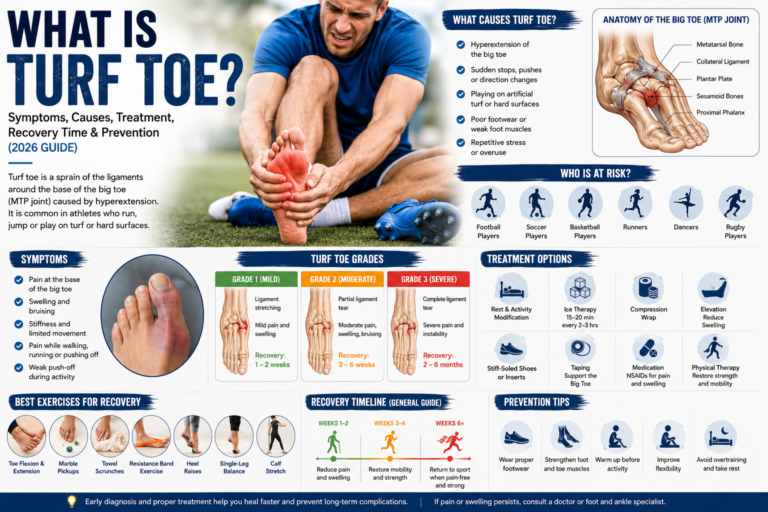
What Is Turf Toe?
If you’ve ever felt a sharp pain at the base of your big toe after sprinting, jumping, or changing direction quickly, you may have experienced turf toe. Despite its name, turf toe isn’t limited to artificial turf fields. It can affect anyone who places repeated stress on the big toe, from professional athletes to weekend runners.
Turf toe is one of the most common sports-related foot injuries, especially in football, soccer, basketball, rugby, and track and field. While mild cases often heal with rest and proper care, severe injuries can lead to long-term pain, joint stiffness, and reduced athletic performance if left untreated.
The good news is that most people recover fully when the injury is recognized early and managed correctly.
In this guide, you’ll learn what turf toe is, what causes it, how to recognize the symptoms, treatment options, recovery timelines, and practical ways to prevent it from happening again.
Quick Answer
Turf toe is a sprain of the ligaments surrounding the first metatarsophalangeal (MTP) joint, the joint where the big toe connects to the foot. The injury usually happens when the big toe bends upward beyond its normal range of motion (hyperextension). Common symptoms include pain, swelling, bruising, and difficulty pushing off while walking or running. Treatment typically involves rest, ice, supportive footwear, physical therapy, and, in severe cases, surgery.
What Is Turf Toe?
Turf toe is a ligament sprain of the big toe joint, specifically the first metatarsophalangeal (MTP) joint. This joint plays a crucial role every time you walk, run, jump, or push off the ground.
Unlike a broken toe, turf toe primarily damages the soft tissues that stabilize the joint. These include the:
- Plantar plate
- Joint capsule
- Collateral ligaments
- Surrounding tendons
- Sesamoid bones (small bones beneath the big toe)
When these structures are overstretched or torn, the joint becomes painful and unstable.
Although the injury is commonly associated with athletes playing on artificial turf—hence the name—it can also occur on natural grass, indoor courts, or even during everyday activities if enough force is applied.
Why Is It Called Turf Toe?
The term “turf toe” became popular in the 1970s when sports medicine specialists noticed an increase in big toe injuries among football players competing on artificial turf.
Artificial surfaces tend to be firmer than natural grass. When an athlete’s shoe grips the turf while the heel lifts off the ground, the big toe can bend excessively upward. This sudden hyperextension places enormous stress on the ligaments supporting the MTP joint.
Today, turf toe affects athletes on all playing surfaces and is no longer considered an injury exclusive to artificial turf.
Understanding the Big Toe Joint (First MTP Joint)
The first metatarsophalangeal joint acts like a hinge that allows your big toe to bend during walking and running.
Several important structures work together to keep this joint stable:
- Metatarsal bone
- Proximal phalanx
- Plantar plate
- Collateral ligaments
- Sesamoid bones
- Flexor hallucis brevis tendon
- Joint capsule
Every step you take places significant pressure on this joint. During sprinting or jumping, the force can exceed several times your body weight. That’s why injuries to this area can make even simple movements painful.
Turf Toe Symptoms
Symptoms vary depending on how severely the ligaments are injured. Some people notice only mild soreness, while others are unable to bear weight on the affected foot.
Common signs include:
Pain at the Base of the Big Toe
The most noticeable symptom is pain around the MTP joint. The discomfort usually worsens when walking, running, climbing stairs, or standing on your toes.
Swelling
Inflammation develops quickly after the injury. Swelling may appear around the joint or spread across the front of the foot.
Bruising
Small tears in the ligaments can cause internal bleeding, leading to bruising on the bottom or top of the big toe.
Limited Range of Motion
Moving the big toe upward or downward may become difficult due to pain and swelling.
Difficulty Walking
Because the big toe is responsible for pushing your body forward, many people begin to limp to avoid putting pressure on the injured joint.
Weak Push-Off
Athletes often notice a loss of power during sprinting, jumping, or changing direction.
Joint Tenderness
Touching the base of the big toe may cause significant discomfort.
Stiffness
As swelling increases, the joint can feel stiff, especially after resting or waking up in the morning.
Symptoms by Injury Grade
| Grade | Symptoms |
| Grade 1 | Mild pain, minimal swelling, slight tenderness, little loss of function |
| Grade 2 | Moderate pain, bruising, swelling, painful walking, reduced mobility |
| Grade 3 | Severe pain, significant swelling, joint instability, inability to bear weight, possible complete ligament tear |
What Causes Turf Toe?
Turf toe develops when the big toe is forced beyond its normal range of motion, especially into hyperextension.
Several situations can cause this injury.
Hyperextension Injury
The most common cause occurs when the heel lifts while the front of the foot remains planted on the ground. As the body continues moving forward, the big toe bends upward excessively, stretching or tearing the supporting ligaments
Sudden Direction Changes
Sports requiring quick acceleration, cutting, pivoting, or jumping place tremendous stress on the first MTP joint.
Examples include:
- Football
- Soccer
- Basketball
- Rugby
- Tennis
- Volleyball
Artificial Turf
Modern athletic shoes often grip artificial turf extremely well. While this improves traction, it can also prevent the foot from sliding naturally, increasing stress on the big toe during explosive movements.
Poor Footwear
Shoes with overly flexible soles provide less support for the forefoot. Without adequate stiffness, the big toe bends more than it should during activity.
Repetitive Stress
Not every turf toe injury happens suddenly. Repeated running, jumping, or high-impact training can gradually weaken the ligaments until a relatively minor movement causes injury.
Direct Impact
A heavy object falling on the toe or another player landing on the foot can also damage the ligaments surrounding the joint.
Who Is Most at Risk?
Although anyone can develop turf toe, certain groups are more vulnerable.
People at higher risk include:
- Football players
- Soccer players
- Rugby players
- Basketball players
- Baseball players
- Sprinters
- Dancers
- Gymnasts
- Martial artists
- Trail runners
- Individuals with flexible feet
- Athletes returning to sport too soon after a previous foot injury
Risk also increases if you:
- Wear flexible athletic shoes.
- Play on hard or artificial surfaces.
- Have weak foot muscles.
- Skip warm-up exercises.
- Have previously injured your big toe.
Why Early Treatment Matters
Many people assume turf toe is “just a sprained toe” and continue training despite the pain. Unfortunately, ignoring the injury can worsen ligament damage and delay healing.
Untreated turf toe may lead to chronic joint instability, reduced flexibility, persistent pain, decreased athletic performance, and even early arthritis in the big toe joint.
Recognizing the symptoms early and seeking appropriate care gives the injured tissues the best chance to heal completely.
Turf Toe Grades, Diagnosis, Treatment & Recovery Exercises
Now that you understand what turf toe is and why it happens, the next step is learning how healthcare professionals assess the injury and which treatments help you recover safely. The severity of the injury determines everything from healing time to whether surgery is necessary.
Turf Toe Grades Explained
Not every turf toe injury is the same. Doctors usually classify it into three grades based on the extent of ligament damage around the first metatarsophalangeal (MTP) joint.
Grade 1 Turf Toe (Mild)
A Grade 1 injury involves stretching of the ligaments without a significant tear.
Symptoms
- Mild pain around the base of the big toe
- Slight swelling
- Minimal tenderness
- Little or no bruising
- Able to walk with mild discomfort
Treatment
- Rest
- Ice therapy
- Compression
- Elevation (RICE)
- Activity modification
- Stiff-soled shoes
Recovery Time
Most people recover within 1 to 2 weeks.
Grade 2 Turf Toe (Moderate)
This grade involves a partial tear of the supporting ligaments.
Symptoms
- Moderate pain
- Noticeable swelling
- Bruising around the joint
- Difficulty walking
- Reduced toe movement
- Pain while pushing off during walking or running
Treatment
- Walking boot
- Toe taping
- Physical therapy
- Anti-inflammatory medication
- Temporary sports restriction
Recovery Time
Recovery usually takes 3 to 6 weeks, depending on activity level.
Grade 3 Turf Toe (Severe)
A Grade 3 injury involves a complete ligament tear or significant damage to the joint capsule and plantar plate.
Symptoms
- Severe pain
- Significant swelling
- Extensive bruising
- Joint instability
- Difficulty bearing weight
- Loss of athletic performance
Treatment
- Immobilization
- MRI evaluation
- Physical therapy
- Surgery in selected cases
Recovery Time
Recovery may take 2 to 6 months, especially for competitive athletes.
Turf Toe vs Other Toe Injuries
Many conditions cause pain around the big toe. Knowing the differences can help you seek the right treatment.
| Condition | Main Difference |
| Turf Toe | Ligament sprain caused by hyperextension |
| Broken Toe | Bone fracture confirmed by X-ray |
| Bunion | Bony bump developing gradually over time |
| Gout | Sudden inflammation caused by uric acid crystals |
| Sesamoiditis | Inflammation beneath the big toe due to overuse |
| Hallux Rigidus | Arthritis causing chronic stiffness of the big toe |
How Doctors Diagnose Turf Toe
Early diagnosis helps prevent long-term complications.
Medical History
Your healthcare provider may ask:
- How did the injury happen?
- Did you hear a pop?
- Can you bear weight?
- Have you injured this foot before?
These details help determine the severity of the injury.
Physical Examination
During the examination, your doctor checks:
- Swelling
- Bruising
- Tenderness
- Joint stability
- Range of motion
- Ability to walk
The injured toe is often gently bent upward to assess ligament damage.
X-Ray
Although turf toe doesn’t involve a broken bone, an X-ray helps rule out:
- Fractures
- Joint dislocation
- Bone fragments
- Arthritis
MRI Scan
An MRI is the most useful imaging test for severe injuries because it shows:
- Ligaments
- Tendons
- Plantar plate
- Joint capsule
- Soft tissue damage
MRI is especially helpful for Grade 2 and Grade 3 injuries.
Ultrasound
In some sports medicine clinics, ultrasound may be used to assess ligament injuries in real time while moving the toe.
Turf Toe Treatment
Treatment depends on the injury grade, your activity level, and whether you’re an athlete.
Immediate First Aid (RICE Method)
The first 48 hours are critical.
Rest
Avoid activities that increase pain.
Ice
Apply ice for 15–20 minutes every 2–3 hours during the first two days.
Never place ice directly on the skin.
Compression
A compression wrap can help reduce swelling.
Elevation
Keep your foot elevated above heart level whenever possible.
Medications
Doctors may recommend nonsteroidal anti-inflammatory drugs (NSAIDs) to reduce pain and inflammation.
Common options include:
- Ibuprofen
- Naproxen
Always follow the recommended dosage and consult your healthcare provider if you have underlying medical conditions.
Supportive Footwear
Changing footwear is one of the simplest ways to protect the injured joint.
Helpful options include:
- Stiff-soled athletic shoes
- Carbon fiber inserts
- Rocker-bottom shoes
- Walking boots (for moderate to severe injuries)
These reduce excessive bending of the big toe during walking.
Turf Toe Taping
Athletic taping limits upward movement of the big toe, allowing the ligaments to heal.
Benefits include:
- Reduced pain
- Better joint stability
- Improved confidence during activity
- Lower risk of reinjury
Many athletes continue taping the toe for several weeks after returning to sports.
Physical Therapy
Physical therapy plays a key role in restoring strength and mobility.
A rehabilitation program may include:
- Toe mobility drills
- Foot strengthening
- Balance exercises
- Calf stretching
- Gait training
- Sport-specific movements
Rehabilitation also helps prevent future injuries.
Best Exercises for Turf Toe Recovery
Once pain and swelling begin to improve, gentle exercises help restore function.
Toe Flexion and Extension
Slowly bend the big toe up and down within a comfortable range.
Repeat 10–15 times.
Marble Pickups
Place marbles on the floor and pick them up using your toes.
This strengthens the small muscles of the foot.
Towel Scrunches
Lay a towel flat on the floor.
Use your toes to pull it toward you.
Repeat several times.
Resistance Band Exercises
Loop a resistance band around the big toe and gently push against it.
This improves strength without excessive joint stress.
Heel Raises
Stand while holding a stable surface.
Slowly rise onto your toes.
Lower back down in a controlled manner.
Begin with body weight before progressing.
Single-Leg Balance
Stand on the injured foot for 20–30 seconds.
This improves stability and coordination.
Calf Stretch
Tight calf muscles increase stress on the forefoot.
Stretching them regularly improves foot mechanics during walking and running.
When Is Surgery Needed?
Fortunately, surgery is uncommon.
However, it may be recommended if you have:
- Complete ligament rupture
- Joint instability
- Large cartilage injury
- Bone fragments
- Failure of conservative treatment
- Chronic pain affecting daily activities
Surgical repair focuses on restoring the damaged ligaments and stabilizing the MTP joint.
After surgery, rehabilitation typically includes several weeks of immobilization followed by a structured physical therapy program.
Returning to Sports
Returning too early can lead to reinjury.
Most sports medicine specialists recommend returning only when you can:
- Walk without pain
- Jog comfortably
- Sprint without discomfort
- Jump normally
- Perform cutting movements confidently
- Push off the injured foot without weakness
A gradual return to activity is safer than rushing back to full training.
