

Have you ever replayed a single critical comment in your mind for days? Or felt crushed after a friend didn’t reply to your message, even though they were probably just busy?
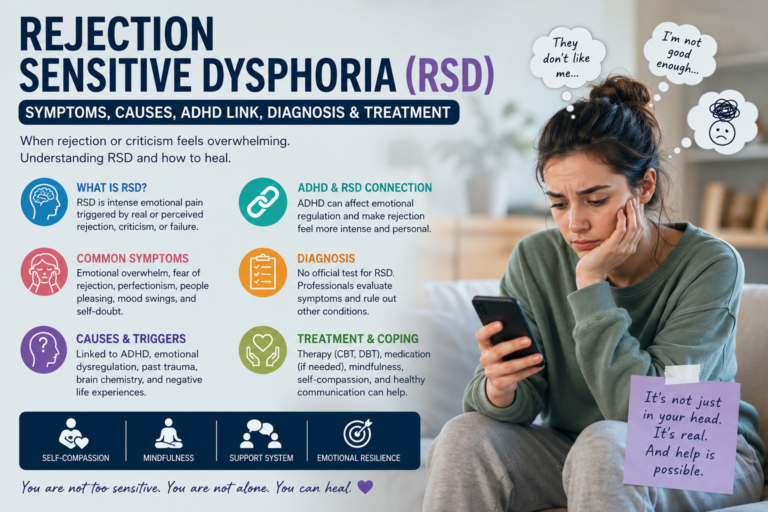
For many people, moments like these are disappointing but manageable. For others, they can trigger an emotional response that feels immediate, intense, and almost unbearable. This experience is often associated with Rejection Sensitive Dysphoria (RSD)—a pattern of extreme emotional pain in response to real or perceived rejection, criticism, or failure.
Although Rejection Sensitive Dysphoria is not currently recognized as a standalone diagnosis in major diagnostic manuals such as the DSM-5, mental health professionals frequently discuss it, especially in relation to Attention-Deficit/Hyperactivity Disorder (ADHD) and emotional dysregulation.
In this comprehensive guide, you’ll learn:
- What Rejection Sensitive Dysphoria really is
- The most common signs and symptoms
- Why it develops
- How it’s connected to ADHD
- Practical ways to manage it and improve emotional well-being
What Is Rejection Sensitive Dysphoria (RSD)?
Rejection Sensitive Dysphoria (RSD) describes an intense emotional reaction to situations involving rejection, criticism, disapproval, or perceived failure. The word “dysphoria” refers to a profound sense of emotional discomfort or distress.
Someone with RSD may interpret even mild feedback as personal rejection. A simple suggestion from a manager, a delayed text message from a partner, or constructive criticism from a teacher can feel emotionally devastating.
Importantly, these reactions are not a sign of weakness or oversensitivity. They often reflect differences in emotional regulation, which are commonly seen in people with ADHD and some other neurodevelopmental or mental health conditions.
Is RSD an Official Mental Health Diagnosis?
This is one of the most common questions people ask.
The answer is no—RSD is not currently listed as an official diagnosis in the Diagnostic and Statistical Manual of Mental Disorders (DSM-5-TR).
However, that does not mean the experience isn’t real.
Many psychologists and psychiatrists recognize that some individuals experience unusually intense emotional responses to rejection or criticism. Rather than diagnosing “RSD” itself, clinicians may evaluate for conditions such as:
- ADHD
- Autism Spectrum Disorder (ASD)
- Anxiety disorders
- Depression
- Borderline Personality Disorder (BPD)
- Trauma-related conditions
RSD is best understood as a pattern of emotional symptoms that often overlaps with these conditions, especially ADHD.
Why Does Rejection Feel So Painful?
Everyone dislikes rejection.
Whether it’s being turned down for a job, ending a relationship, or receiving criticism, rejection naturally hurts.
For someone with RSD, however, the emotional response is often far more intense than the situation objectively warrants.
Their brain may rapidly interpret events as:
- “I’m not good enough.”
- “Everyone dislikes me.”
- “I always fail.”
- “I’m going to be abandoned.”
These thoughts can appear within seconds and trigger powerful emotional reactions before logical reasoning has time to catch up.
Researchers believe this may involve differences in emotional regulation networks within the brain, including areas such as the amygdala (which processes emotional threats) and the prefrontal cortex (which helps regulate emotional responses). Neurotransmitters such as dopamine and norepinephrine—both closely linked with ADHD—may also play a role.
Signs and Symptoms of Rejection Sensitive Dysphoria
RSD doesn’t look exactly the same in everyone.
Some people become visibly emotional, while others hide their feelings behind perfectionism or people-pleasing behaviors.
Emotional Symptoms
Common emotional experiences include:
- Extreme emotional pain after criticism
- Fear of disappointing others
- Feeling embarrassed very easily
- Intense shame
- Persistent self-doubt
- Sudden sadness
- Anxiety before receiving feedback
- Feeling emotionally overwhelmed
- Fear of abandonment
- Mood swings triggered by rejection
Many people describe these emotions as feeling instantaneous and overwhelming, almost like an emotional switch has been flipped.
Behavioral Symptoms
RSD can also influence daily behavior.
Examples include:
- Avoiding situations where failure is possible
- Constantly seeking reassurance
- Perfectionism
- Working excessively to avoid criticism
- People-pleasing
- Difficulty saying “no”
- Avoiding new relationships
- Social withdrawal after conflict
- Giving up quickly after setbacks
Someone may appear highly successful on the outside while privately struggling with an overwhelming fear of making mistakes.
Cognitive Symptoms
Thought patterns commonly include:
- Assuming others are angry
- Overthinking conversations
- Replaying interactions repeatedly
- Expecting rejection before it happens
- Catastrophic thinking
- Negative self-talk
- Difficulty accepting compliments
These thinking patterns often reinforce emotional distress, creating a cycle that’s difficult to break without support.
Physical Reactions
Although RSD is emotional, it can produce physical symptoms too.
Some individuals report:
- Racing heartbeat
- Tight chest
- Sweating
- Upset stomach
- Muscle tension
- Headaches
- Difficulty sleeping after conflict
- Fatigue from prolonged emotional stress
The body’s stress response can become activated even when the perceived rejection is relatively minor.
What Causes Rejection Sensitive Dysphoria?
There isn’t a single cause.
Instead, experts believe RSD develops through a combination of neurological, psychological, and environmental factors.
1. ADHD and Emotional Dysregulation
The strongest association is with Attention-Deficit/Hyperactivity Disorder (ADHD).
While ADHD is commonly known for inattention and hyperactivity, it also affects executive functioning and emotional regulation.
People with ADHD may experience:
- Stronger emotional reactions
- Difficulty calming down
- Greater impulsivity
- Challenges managing frustration
These differences can make experiences of rejection feel especially painful.
2. Brain Chemistry
Researchers continue studying how neurotransmitters influence emotional regulation.
Particular attention has focused on:
- Dopamine
- Norepinephrine
These chemicals help regulate attention, motivation, reward processing, and emotional responses. Differences in these systems may contribute to heightened sensitivity in some individuals.
3. Childhood Experiences
Early life experiences can shape how someone responds to rejection later in life.
Potential contributing factors include:
- Chronic criticism
- Emotional neglect
- Bullyin
- Unpredictable parenting
- Family conflict
- Unrealistic expectations
- Repeated experiences of failure
These experiences don’t guarantee someone will develop RSD, but they may increase vulnerability.
4. Trauma
Past emotional trauma can heighten sensitivity to situations that resemble earlier painful experiences.
For example:
- Relationship betrayal
- Emotional abuse
- School bullying
- Workplace humiliation
The brain may become more alert to possible rejection as a protective mechanism—even when no real threat exists.
5. Personality and Temperament
Some people naturally experience emotions more intensely than others.
Traits such as:
- High empathy
- Emotional sensitivity
- Perfectionism
- Strong desire for approval
may amplify reactions to criticism or rejection, particularly when combined with ADHD or past adversity.
Can You Have RSD Without ADHD?
Yes.
Although RSD is most commonly discussed alongside ADHD, not everyone who experiences intense rejection sensitivity has ADHD.
Similar emotional patterns may also occur in people with:
- Autism Spectrum Disorder (ASD)
- Social Anxiety Disorder
- Generalized Anxiety Disorder
- Depression
- Post-Traumatic Stress Disorder (PTSD)
- Complex PTSD
- Borderline Personality Disorder (BPD)
However, the reasons behind these reactions may differ. That’s why a comprehensive mental health assessment is important rather than assuming a specific diagnosis based on symptoms alone.
The Strong Connection Between ADHD and Rejection Sensitive Dysphoria
If you’ve spent any time reading about Rejection Sensitive Dysphoria (RSD), you’ve probably noticed that it almost always comes up alongside Attention-Deficit/Hyperactivity Disorder (ADHD). That’s because many clinicians and researchers believe the two are closely linked.
ADHD is often misunderstood as simply a condition involving distraction or hyperactivity. In reality, it also affects executive functioning, emotional regulation, impulse control, and the brain’s ability to manage stress.
For many people with ADHD, emotions don’t just feel stronger—they can arrive suddenly, feel overwhelming, and take longer to settle. That’s one reason why rejection, criticism, or perceived disapproval may feel much more painful than expected.
It’s important to note that not everyone with ADHD experiences RSD, and not everyone with RSD has ADHD. However, the overlap is significant enough that many mental health professionals consider rejection sensitivity an important part of understanding ADHD in everyday life.
Why Does ADHD Increase Emotional Sensitivity?
Researchers are still learning about the brain mechanisms involved, but several factors may contribute:
Emotional Dysregulation
People with ADHD often struggle to regulate emotions. Instead of gradually feeling upset, they may experience an emotional “surge” that’s difficult to control.
Executive Dysfunction
Executive functions help us pause, evaluate situations, and respond thoughtfully. When these processes are impaired, the brain may react emotionally before logic has a chance to intervene.
Past Experiences
Many adults with ADHD have experienced years of:
- Academic struggles
- Workplace criticism
- Relationship misunderstandings
- Social rejection
- Being labeled as “lazy” or “careless”
Over time, repeated negative experiences can make the brain more alert to the possibility of future rejection.
Common Triggers of Rejection Sensitive Dysphoria
One of the challenges of living with RSD is that triggers are often subtle. What seems like an ordinary interaction to one person can feel deeply personal to someone experiencing rejection sensitivity.
Some of the most common triggers include:
Constructive Criticism
Even gentle feedback can feel like a personal attack.
For example:
Instead of hearing, “This report needs a few edits,” the person may internally hear:
“I’m terrible at my job.”
Being Ignored
Not receiving a reply to a text message, email, or phone call may quickly lead to assumptions such as:
- They’re upset with me.
- I did something wrong.
- They don’t like me anymore.
In many cases, the other person is simply busy.
Relationship Conflict
Minor disagreements with a partner, friend, or family member may trigger:
- Fear of abandonment
- Panic
- Intense sadness
- Emotional withdrawal
- Anger or defensiveness
Workplace Feedback
Performance reviews, corrections, or suggestions from a supervisor may feel devastating—even when they’re intended to help.
This can lead to:
- Self-doubt
- Avoiding new responsibilities
- Fear of asking questions
- Burnout from trying to be perfect
Social Media
Modern technology has introduced entirely new forms of perceived rejection.
Examples include:
- Not receiving likes
- Being left on “read”
- Seeing friends gather without you
- Negative comments online
- Comparing yourself to others
For someone with RSD, these experiences may trigger hours or even days of emotional distress.
What Does Rejection Sensitive Dysphoria Feel Like?
Many people describe RSD as emotional pain that appears almost instantly.
Some common descriptions include:
- “It feels like my heart drops.”
- “I can’t stop thinking about one comment.”
- “I know I’m overreacting, but I can’t stop.”
- “It’s like my brain convinces me everyone hates me.”
- “One criticism ruins my entire day.”
The key feature isn’t simply sadness—it’s the intensity of the emotional response.
Real-Life Examples of RSD
Example 1: Constructive Feedback at Work
Sarah submits a presentation.
Her manager says,
“Overall, this looks great. Let’s improve a few sections.”
Instead of focusing on the positive feedback, Sarah spends the entire evening convinced she’s failing at her job.
She loses sleep replaying the conversation repeatedly.
Example 2: A Delayed Text Message
Ahmed texts his best friend.
Several hours pass without a reply.
His thoughts immediately become:
- Did I say something wrong?
- Are they angry?
- Are they avoiding me?
Later, he discovers his friend was simply attending a meeting.
Example 3: Not Getting the Promotion
Michael applies for a promotion.
Another employee gets the position.
Instead of thinking,
“I’ll improve my skills for next time,”
he concludes,
“I’m not good enough. I’ll never succeed.”
He withdraws from new opportunities for months.
Example 4: Family Criticism
A parent says,
“You forgot to call yesterday.”
Although the comment is brief, it feels like proof that they’re a disappointment.
The emotional reaction lasts much longer than the conversation itself.
How RSD Affects Relationships
Relationships often become one of the biggest challenges for people experiencing rejection sensitivity.
Romantic Relationships
Someone with RSD may:
- Need frequent reassurance
- Worry about abandonment
- Misinterpret neutral comments
- Over-apologize
- Avoid discussing difficult topics
Partners may mistakenly believe they’re “too sensitive,” when in reality they’re experiencing genuine emotional distress.
Friendships
Friendships may become difficult because someone with RSD might:
- Assume friends secretly dislike them
- Withdraw after minor misunderstandings
- Cancel plans out of fear of rejection
- Avoid making new friends altogether
Family Relationships
Family members may notice:
- Strong emotional reactions to criticism
- Difficulty accepting advice
- Feeling hurt by jokes or teasing
- Constant attempts to gain approval
Supportive communication can make a significant difference.
RSD in the Workplace
The workplace presents many situations that can trigger rejection sensitivity.
Common challenges include:
- Fear of performance reviews
- Avoiding leadership roles
- Difficulty accepting feedback
- Perfectionism
- Imposter syndrome
- Burnout
- Excessive overtime
- Reluctance to ask questions
Ironically, many employees with RSD are extremely hardworking because they’re trying to avoid making mistakes.
Can RSD Affect Students?
Absolutely.
Children, teenagers, and college students may experience:
- Fear of answering questions in class
- Anxiety before exams
- Emotional reactions to grades
- Avoiding sports or competitions
- Difficulty making friends
- Perfectionism in schoolwork
Teachers may interpret these behaviors as laziness or lack of confidence when they’re actually driven by fear of rejection.
How Is Rejection Sensitive Dysphoria Diagnosed?
At present, there is no official diagnostic test specifically for RSD.
Instead, a licensed psychologist or psychiatrist will usually perform a comprehensive mental health assessment.
The evaluation may include:
- Medical history
- Emotional symptoms
- ADHD screening
- Anxiety assessment
- Depression screening
- Trauma history
- Behavioral patterns
- Daily functioning
The goal is to understand the underlying cause of emotional distress rather than simply assigning a label.
Conditions That Can Look Similar to RSD
Because emotional sensitivity occurs in several mental health conditions, healthcare providers may consider whether symptoms are better explained by:
- ADHD
- Autism Spectrum Disorder (ASD)
- Social Anxiety Disorder
- Generalized Anxiety Disorder
- Major Depressive Disorder
- Borderline Personality Disorder (BPD)
- Complex PTSD
- Bipolar Disorder (depending on symptom patterns)
A careful assessment helps ensure that treatment is tailored to the individual’s needs.
Can You Take an Online RSD Test?
You may find many online quizzes claiming to diagnose Rejection Sensitive Dysphoria.
These tools can sometimes help you reflect on your experiences, but they cannot confirm whether you have RSD or any mental health condition.
If rejection sensitivity is affecting your relationships, work, education, or emotional well-being, it’s best to speak with a qualified mental health professional for a thorough evaluation.
