

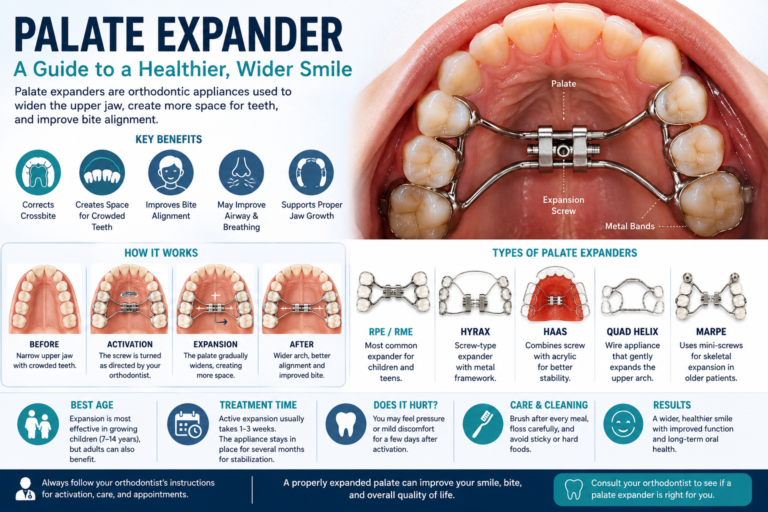
A palate expander is an orthodontic appliance used to widen the upper jaw when it is too narrow for proper dental or bite development. Orthodontists commonly recommend palatal expansion for problems such as a posterior crossbite, a narrow upper dental arch, or certain forms of dental crowding.
Treatment can look quite different from one person to another. A growing child may respond differently from an adult, and the type of appliance used depends on the patient’s age, jaw development, orthodontic problem, and treatment goals.
This guide explains what a palate expander does, how it works, different types, the best age for treatment, pain, treatment time, cost, possible side effects, eating and cleaning tips, and what to expect after expansion.
Medical note: Palate expansion is an individualized orthodontic treatment. An orthodontist should determine whether expansion is appropriate and which appliance is suitable for a particular patient.
What Is a Palate Expander?
A palate expander, also called a palatal or maxillary expander, is an orthodontic appliance designed to increase the width of the upper jaw or upper dental arch.
The upper jaw is called the maxilla. When the maxilla is relatively narrow compared with the lower jaw, it can contribute to certain bite problems, particularly a posterior crossbite.
A palate expander applies controlled forces to gradually widen the upper arch. Depending on the patient’s age and the appliance being used, expansion may involve primarily dental movement, skeletal changes, or a combination of both.
What Does a Palate Expander Do?
A palate expander may help an orthodontist:
- Widen a narrow upper dental arch
- Correct certain posterior crossbites
- Create additional space for crowded teeth
- Improve the relationship between the upper and lower jaws
- Support comprehensive orthodontic treatment
- Address certain problems associated with a narrow maxilla
The goal isn’t simply to make the mouth wider. The orthodontist considers the patient’s facial growth, dental alignment, bite, and overall skeletal structure when planning treatment.
Why Would Someone Need a Palate Expander?
An orthodontist may consider expansion when the upper jaw is narrower than appropriate for the patient’s bite.
Common reasons include:
- Narrow maxilla
- Posterior crossbite
- Dental arch constriction
- Certain forms of crowding
- Transverse jaw discrepancies
- Some orthodontic development problems
Not every person with crowded teeth or a crossbite needs a palate expander. The cause of the problem matters.
How Does a Palate Expander Work?
The basic principle is straightforward: an orthodontic appliance applies controlled force to increase the width of the upper dental arch.
However, the biological process is more complex.
How Palatal Expansion Changes the Upper Jaw
In growing patients, the two halves of the maxilla are connected by a structure called the midpalatal suture. Depending on skeletal maturity and the type of appliance, orthodontic expansion can influence this region.
Expansion may produce:
- Skeletal widening
- Dental movement
- Changes in the shape of the dental arch
- Improved transverse relationship between the upper and lower teeth
The amount of skeletal versus dental expansion varies considerably between patients.
What Is the Expansion Screw?
Many traditional expanders contain a small expansion screw in the center of the appliance.
The orthodontist provides specific instructions about when and how the appliance should be activated. Turning the screw gradually changes the width of the appliance and applies controlled pressure.
Patients should never change the activation schedule on their own. The exact number and frequency of turns depend on the treatment plan.
What Happens During Palate Expansion?
Treatment generally follows several stages:
Evaluation → appliance placement → activation → monitoring → stabilization → retention
The orthodontist may use dental impressions, digital scans, photographs, X-rays, or other diagnostic information to plan treatment.
Why Do Orthodontists Use Palate Expanders?
Correcting a Narrow Upper Jaw
A narrow maxilla can create an unfavorable relationship between the upper and lower dental arches.
Expansion may help establish a better transverse relationship between them.
Treating a Posterior Crossbite
A posterior crossbite occurs when some upper back teeth bite inside the corresponding lower teeth rather than outside them.
Depending on the cause and the patient’s development, maxillary expansion may be part of treatment.
Creating Space for Crowded Teeth
Expansion can sometimes increase available arch width and space. However, it isn’t a universal solution for every type of dental crowding.
The orthodontist determines whether expansion is appropriate based on the underlying anatomy.
Supporting Comprehensive Orthodontic Treatment
A palate expander may be used before, during, or as part of a broader orthodontic treatment plan that can include braces or clear aligners.
Types of Palate Expanders
There isn’t just one type of palate expander. The appliance selected depends on factors such as age, skeletal maturity, dental condition, and treatment objectives.
Rapid Palatal Expander (RPE)
A rapid palatal expander (RPE) is designed to expand the upper arch over a relatively short active-expansion period.
It is commonly used in growing patients when the orthodontist believes rapid expansion is appropriate.
Rapid Maxillary Expander (RME)
The terms rapid maxillary expansion and rapid palatal expansion are often used when describing expansion of the upper jaw.
The specific appliance and treatment protocol can vary.
Hyrax Expander
A Hyrax is a commonly used fixed expansion appliance that typically incorporates an expansion screw.
It is generally anchored to teeth and/or other supporting structures depending on the design.
Haas Expander
The Haas expander is another type of fixed palatal expansion appliance. Its design includes acrylic components that contact the palate in addition to dental anchorage.
Quad Helix
A Quad Helix is a fixed orthodontic appliance that can be used to expand the upper dental arch gradually.
It differs mechanically from traditional screw-type expanders.
Removable Palate Expander
Some expansion appliances are removable. These may be appropriate in selected situations, although their suitability depends on the specific orthodontic problem and treatment goals.
Fixed Palate Expander
A fixed expander remains attached to the teeth during the active treatment period. This can help maintain consistent appliance placement and expansion according to the orthodontist’s protocol.
MARPE
Miniscrew-assisted rapid palatal expansion (MARPE) uses temporary anchorage devices, often called mini-implants or miniscrews, to apply more force directly to the skeletal structures.
MARPE may be considered in some adolescents and adults when conventional tooth-supported expansion may be less predictable.
SARPE
Surgically assisted rapid palatal expansion (SARPE) combines orthodontic expansion with a surgical procedure.
It may be considered for selected skeletally mature patients when nonsurgical expansion is not considered appropriate or predictable.
Who Needs a Palate Expander?
Palate Expander for Children
Children are often good candidates for certain types of palatal expansion because the facial bones and jaws are still developing.
An orthodontist may recommend expansion for a child with:
- A narrow upper jaw
- Posterior crossbite
- Certain arch-development problems
- Specific crowding patterns
The exact timing depends on the child’s dental and skeletal development rather than age alone.
Palate Expander for Teenagers
Teenagers may still benefit from expansion, but the approach depends on their stage of growth and skeletal maturity.
An orthodontist may evaluate whether a conventional expander is appropriate or whether another approach would provide more predictable results.
Palate Expander for Adults
Adult palate expansion requires special consideration because the midpalatal suture and surrounding structures become more mature with age.
Conventional tooth-supported expansion may not produce the same skeletal effects seen in younger patients.
Depending on the individual case, an orthodontist may consider options such as:
- MARPE
- Other skeletal expansion approaches
- Surgically assisted expansion
Adult treatment should therefore be planned individually rather than assuming that one appliance works for everyone.
What Is the Best Age for a Palate Expander?
There isn’t one universal “best age” for a palate expander.
Treatment timing depends on:
- Skeletal development
- Dental development
- Growth stage
- Severity of the transverse discrepancy
- Type of bite problem
- Treatment objectives
In younger patients, the developing maxilla may respond differently to expansion than a fully mature adult jaw.
Is It Too Late to Get a Palate Expander?
Being older does not automatically mean expansion is impossible.
However, skeletal maturity changes the treatment approach. An adult may require a different type of expansion than a young child.
The best way to determine suitability is through an orthodontic examination and appropriate diagnostic assessment.
Palate Expander Treatment Process
1. Initial Orthodontic Evaluation
The orthodontist examines the teeth, bite, upper jaw, facial structure, and overall dental development.
Diagnostic records may include:
- Digital scans
- Dental photographs
- X-rays
- Dental impressions
- Bite measurements
2. Choosing the Right Expander
The orthodontist selects an appliance based on the patient’s anatomy, age, growth stage, and treatment goals.
3. Fitting the Appliance
The expander is carefully fitted so that it sits securely and can deliver the intended forces.
4. Activating the Expander
If the appliance uses an expansion screw, the orthodontist provides specific instructions for activation.
Some treatment plans involve activation at home, while others may be managed differently.
5. Monitoring Progress
Regular appointments allow the orthodontist to assess:
- Expansion
- Bite changes
- Appliance fit
- Oral hygiene
- Tooth movement
- Patient comfort
6. Stabilization and Retention
Once the desired expansion has been achieved, the appliance may remain in place for a period of stabilization.
This is important because the tissues surrounding the teeth and jaw need time to adapt.
Does a Palate Expander Hurt?
One of the most common concerns is “Does a palate expander hurt?”
Most patients describe pressure, tightness, or temporary soreness rather than severe pain.
What Does a Palate Expander Feel Like?
You may notice:
- Pressure around the upper teeth
- Tightness in the palate
- Mild soreness
- Increased saliva
- Temporary difficulty speaking
- A feeling of fullness in the mouth
These sensations can be more noticeable after activation.
Does Turning a Palate Expander Hurt?
Activation may cause temporary pressure or discomfort because the appliance is applying additional force.
However, pain levels vary between individuals.
If activation causes severe or persistent pain, contact the orthodontist rather than continuing to make unscheduled adjustments.
How Can You Manage Discomfort?
Depending on your orthodontist’s advice, helpful measures may include:
- Eating softer foods temporarily
- Drinking plenty of water
- Following the prescribed activation schedule
- Maintaining good oral hygiene
- Using only recommended pain-relief measures
How Long Do You Wear a Palate Expander?
Treatment time varies considerably.
There are generally two phases to consider:
Active Expansion
This is the period during which the appliance is actively widening the upper arch.
Stabilization
After the desired expansion is achieved, the appliance may remain in place to allow the surrounding tissues and structures to stabilize.
The total treatment duration depends on:
- Age
- Type of expander
- Degree of expansion needed
- Skeletal maturity
- Individual response
- Orthodontist’s treatment plan
There is no single number of days or weeks that applies to every patient.
Palate Expander Before and After
Patients often search for palate expander before and after photos because they want to know what changes they can expect.
Potential changes may include:
- Increased upper arch width
- Correction of certain crossbites
- Improved relationship between upper and lower teeth
- Additional space within the dental arch
- Changes in tooth positioning
However, results vary substantially.
Palate Expander Teeth Before and After
The teeth may appear more widely spaced during or after active expansion. This does not necessarily mean something has gone wrong.
In some cases, a temporary gap can develop between the upper front teeth during expansion. The orthodontist monitors this as part of treatment.
Adult Palate Expander Before and After
Adults may experience different expansion patterns because their skeletal structures are more mature.
Consequently, adult results should not be compared directly with those of young children.
Palate Expander Benefits
When appropriately prescribed, palate expansion may provide several orthodontic benefits.
Correcting Certain Crossbites
Expansion can help address some posterior crossbites caused by a narrow upper jaw.
Expanding the Upper Dental Arch
The treatment can increase transverse arch width and improve the relationship between the upper and lower arches.
Creating Additional Space
In selected patients, expansion may provide additional room within the dental arch.
Supporting Orthodontic Treatment
A palate expander may be used as one stage of a broader treatment plan involving braces, aligners, or other orthodontic appliances.
Palate Expander Side Effects and Risks
Palatal expansion is generally considered a well-established orthodontic treatment, but temporary effects and complications can occur.
Common Temporary Effects
Patients may experience:
- Pressure
- Soreness
- Increased saliva
- Speech changes
- Difficulty eating initially
- Food collecting around the appliance
These effects often become easier to manage as the patient becomes accustomed to the appliance.
Oral Hygiene Problems
Because the appliance creates additional areas where food can become trapped, maintaining oral hygiene is especially important.
Poor cleaning can contribute to plaque accumulation and gum irritation.
Dental Changes
Expansion can influence tooth position and the bite. The orthodontist monitors these changes during follow-up visits.
When Should You Contact Your Orthodontist?
Contact your orthodontic office if you experience:
- Severe or worsening pain
- A loose appliance
- Broken components
- Significant gum injury
- Persistent swelling
- Difficulty with the appliance that doesn’t improve
- An activation problem
Don’t attempt to repair or modify the expander yourself.
Can a Palate Expander Change Your Face?
This is another popular question.
Palatal expansion can alter the width of the upper dental arch and, depending on the patient and treatment, influence aspects of the underlying maxillary structure.
However, online claims that palate expanders dramatically transform someone’s face should be treated cautiously.
Does Palate Expansion Make Your Face Wider?
The treatment is primarily intended to address an orthodontic or skeletal discrepancy involving the upper jaw.
Any visible facial changes depend on factors such as:
- Age
- Growth
- Type of expansion
- Amount of expansion
- Skeletal anatomy
- Overall orthodontic treatment
A palate expander should not be viewed as a cosmetic facial-widening device.
Palate Expander and Breathing
You may see claims online that palate expansion can improve breathing or the airway.
The relationship between maxillary expansion, nasal airflow, and airway dimensions is an area of clinical interest, but the effects vary between patients.
Can Palate Expansion Improve Nasal Breathing?
Some studies have reported changes in nasal dimensions or airflow following maxillary expansion, particularly in selected patients.
However, that does not mean every person will experience noticeable improvement in breathing.
Palate Expansion and Sleep Apnea
A palate expander should not automatically be considered a treatment for obstructive sleep apnea.
Anyone with symptoms such as loud habitual snoring, witnessed pauses in breathing, gasping during sleep, or excessive daytime sleepiness should receive an appropriate medical evaluation.
Eating With a Palate Expander
Eating can feel strange during the first few days.
What Can You Eat With a Palate Expander?
During the adjustment period, many patients find softer foods easier, such as:
- Yogurt
- Eggs
- Pasta
- Soft vegetables
- Rice
- Smooth foods
- Tender meats
As you become accustomed to the appliance, your orthodontist may allow a more normal diet.
Foods to Avoid
Avoid foods that are especially hard, sticky, or likely to damage or pull on the appliance.
Examples may include:
- Very hard candies
- Sticky sweets
- Chewy foods
- Hard ice
- Extremely tough foods
Your orthodontist may provide specific dietary instructions based on your appliance.
Why Does Food Get Stuck in the Expander?
The expander has areas that naturally create spaces where food particles can collect.
This is why careful brushing and cleaning are essential throughout treatment.
How to Clean a Palate Expander
Good oral hygiene helps reduce plaque buildup and gum irritation.
Brushing Around the Appliance
Use a toothbrush to carefully clean around:
- The teeth supporting the expander
- The appliance itself
- The gumline
- Areas around the palate
Cleaning Food From the Expander
Your orthodontist may recommend specific tools or techniques for removing food debris.
Depending on the appliance, these may include an orthodontic brush, water flosser, or other cleaning aids.
Maintaining Good Oral Hygiene
Continue your normal dental hygiene routine while paying extra attention to areas around the appliance.
Regular dental checkups should also continue unless your dental professional advises otherwise.
Palate Expander Cost
The palate expander cost can vary substantially.
Factors that influence the total price include:
- Type of appliance
- Treatment complexity
- Orthodontist’s fees
- Geographic location
- Diagnostic testing
- Follow-up visits
- Whether additional orthodontic treatment is required
- Dental insurance coverage
Does Insurance Cover a Palate Expander?
Coverage varies between insurance plans.
Some orthodontic benefits may contribute toward medically or orthodontically necessary treatment, while others have limitations, age restrictions, or waiting periods.
Before starting treatment, ask your orthodontist’s office and insurance provider about expected out-of-pocket costs.
Palate Expander and Braces
A palate expander and braces serve different primary purposes.
A palate expander focuses on expanding the upper arch or addressing transverse discrepancies, while braces primarily move individual teeth into better alignment.
Do You Need Braces After a Palate Expander?
Not everyone necessarily needs braces afterward.
However, many patients receive additional orthodontic treatment to align teeth after expansion.
Can You Have Braces and a Palate Expander at the Same Time?
In some treatment plans, yes.
The timing depends on the patient’s orthodontic needs and the treatment strategy selected by the orthodontist.
Which Comes First: Palate Expander or Braces?
When expansion is necessary, an orthodontist may use the expander before braces, alongside braces, or as part of a larger treatment sequence.
There isn’t one universal order.
Palate Expander Alternatives
Traditional palate expansion isn’t appropriate for every patient.
Potential alternatives or different approaches may include:
MARPE
Miniscrew-assisted rapid palatal expansion uses skeletal anchorage and may be considered for selected older adolescents or adults.
SARPE
Surgically assisted rapid palatal expansion combines surgical assistance with orthodontic expansion and may be considered for selected skeletally mature patients.
Other Orthodontic Appliances
Depending on the problem, an orthodontist may recommend another appliance or treatment approach instead of traditional palatal expansion.
The right option depends on whether the problem is primarily dental, skeletal, or a combination of both.
Palate Expander vs MARPE vs SARPE
| Feature | Traditional Palate Expander | MARPE | SARPE |
|---|---|---|---|
| Main purpose | Upper-jaw/arch expansion | Skeletal maxillary expansion | Surgically assisted expansion |
| Common use | Often growing patients | Selected older adolescents/adults | Selected skeletally mature patients |
| Surgery | No | Usually no | Yes |
| Anchorage | Typically dental or appliance-dependent | Miniscrews | Surgical + orthodontic |
| Suitability | Case-dependent | Case-dependent | Case-dependent |
An orthodontist determines which option is appropriate after evaluating skeletal maturity and the nature of the jaw discrepancy.
What Happens After Palate Expansion?
Finishing the active expansion doesn’t necessarily mean treatment is over.
Retention Phase
The orthodontist may keep the appliance in place for a period after active expansion to help stabilize the result.
Braces or Aligners
If tooth alignment is also needed, braces or clear aligners may follow.
Monitoring the Bite
Follow-up appointments allow the orthodontist to check whether the upper and lower teeth are maintaining their intended relationship.
Maintaining the Expansion
Retention is important because teeth and supporting tissues can change after active orthodontic forces stop.
Frequently Asked Questions About Palate Expanders
What is a palate expander?
A palate expander is an orthodontic appliance used to widen the upper dental arch or maxilla in selected patients.
Why would a child need a palate expander?
A child may need one if they have a narrow upper jaw, posterior crossbite, or another orthodontic problem that may benefit from maxillary expansion.
Does a palate expander hurt?
Most people experience pressure or temporary discomfort rather than severe pain. Individual experiences vary.
Can adults get a palate expander?
Yes, adults can receive forms of maxillary expansion in appropriate cases. Because skeletal maturity affects treatment, adult expansion may require specialized approaches such as MARPE or, in selected cases, SARPE.
What is the best age for a palate expander?
There is no single ideal age for everyone. Treatment timing depends on growth, skeletal maturity, dental development, and the specific orthodontic problem.
How long do you wear a palate expander?
The active expansion period and total time the appliance remains in place vary according to the treatment plan and individual response.
How much does a palate expander cost?
Cost varies by location, appliance type, treatment complexity, orthodontist, insurance, and whether additional treatment is required.
Can a palate expander fix a crossbite?
A palate expander can be an effective treatment for certain types of posterior crossbite, particularly when a narrow upper jaw contributes to the problem.
Can a palate expander fix crowded teeth?
Expansion may create additional arch width or space in selected cases, but it is not a solution for every type of dental crowding.
Can a palate expander change your face?
Expansion can affect the upper dental arch and, depending on age and treatment, aspects of maxillary structure. Significant facial changes should not be assumed or guaranteed.
Can you eat normally with a palate expander?
Most patients adapt to eating with the appliance. Softer foods may be easier initially, while very hard or sticky foods may need to be avoided.
How do you clean a palate expander?
Brush carefully around the teeth and appliance, remove trapped food, and follow the cleaning instructions provided by your orthodontist.
Do you need braces after a palate expander?
Not always, but many patients need additional orthodontic treatment to align their teeth after expansion.
What happens after palate expansion?
The expansion is generally stabilized, followed by continued monitoring and, when necessary, braces, aligners, or other orthodontic treatment.
Is palate expansion safe?
Palatal expansion is a well-established orthodontic procedure when appropriately planned and monitored. As with any treatment, there can be temporary discomfort and potential complications, so treatment should be supervised by a qualified orthodontic professional.
Key Takeaways
A palate expander is an orthodontic appliance used to address certain problems involving the width of the upper jaw and dental arch. It is particularly relevant for conditions such as a narrow maxilla and some posterior crossbites.
The most important points are:
- Palate expanders widen the upper dental arch or maxilla.
- They are commonly used in growing patients, but selected adults may also benefit from specialized expansion.
- Several appliances exist, including RPE, RME, Hyrax, Haas, Quad Helix, MARPE, and SARPE.
- Treatment can involve dental expansion, skeletal expansion, or both.
- Temporary pressure, soreness, speech changes, and increased saliva are possible.
- Treatment duration varies from patient to patient.
- Good oral hygiene is essential while wearing an expander.
- Cost depends on the appliance, location, orthodontist, insurance, and treatment complexity.
- Braces or aligners may be needed after expansion.
- Adults often require a more individualized approach because skeletal maturity affects expansion.
- An orthodontist should determine whether palatal expansion is appropriate and which treatment method is safest and most predictable for the individual.
