

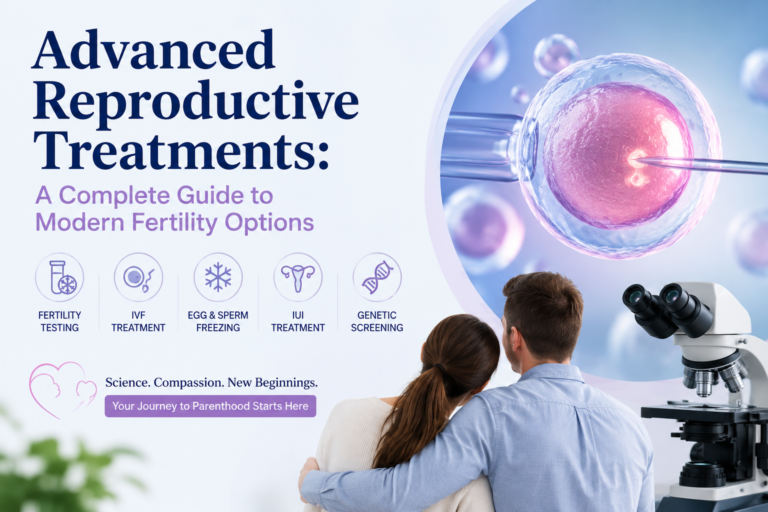
For anyone who’s spent months — or years — trying to conceive, the phrase “advanced reproductive treatments” can feel both hopeful and overwhelming at the same time. There are so many acronyms floating around (IVF, IUI, ICSI, PGT) that it’s easy to get lost before you even understand what any of them actually involve. This guide breaks it all down in plain language: what these treatments are, how they work, what they cost, what the odds really look like, and — just as importantly — what the emotional side of this journey tends to look like.
What Are Advanced Reproductive Treatments?
Advanced reproductive treatments fall under a broader medical category called Assisted Reproductive Technology (ART) — a group of procedures designed to help people conceive when natural conception isn’t happening on its own, whether due to age, hormonal imbalance, structural issues, or unexplained infertility.
Assisted Reproductive Technology (ART) Explained
ART covers any fertility treatment that involves handling eggs, sperm, or embryos outside the body. This includes everything from simple insemination procedures to full laboratory-based fertilization. The World Health Organization and reproductive bodies like the American Society for Reproductive Medicine (ASRM) classify these treatments by complexity — ranging from ovulation-stimulating medications all the way to full IVF cycles with genetic screening.
Who Needs Advanced Reproductive Treatment?
People turn to these treatments for a wide range of reasons:
- Couples who’ve been trying to conceive for 12+ months without success (or 6 months if the woman is over 35)
- Individuals with diagnosed conditions like PCOS, endometriosis, or blocked fallopian tubes
- Men with low sperm count, poor motility, or structural issues
- Same-sex couples and single parents by choice who need donor sperm, donor eggs, or a gestational carrier
- People pursuing fertility preservation before medical treatments (like chemotherapy) or simply to delay childbearing
How Reproductive Medicine Has Evolved
The field has come a long way since the first IVF birth in 1978. What used to be a last-resort, low-success procedure is now a highly refined, technology-driven process — with genetic screening, better lab conditions, and individualized hormone protocols significantly improving outcomes over the past two decades.
Types of Advanced Reproductive Treatments
This is really the heart of what most people are searching for — a clear picture of what each treatment actually involves.
IVF (In Vitro Fertilization)
IVF is the most well-known and widely used advanced fertility treatment. The process involves stimulating the ovaries to produce multiple eggs, retrieving those eggs surgically, fertilizing them with sperm in a lab, and transferring the resulting embryo(s) into the uterus. It’s typically recommended for blocked fallopian tubes, severe male infertility, unexplained infertility, or after other treatments haven’t worked.
ICSI (Intracytoplasmic Sperm Injection)
ICSI is often paired with IVF, but it targets male-factor infertility specifically. Instead of letting sperm fertilize the egg naturally in a lab dish, an embryologist injects a single sperm directly into the egg. It’s commonly used when sperm count, motility, or shape (morphology) is a limiting factor.
IUI (Intrauterine Insemination)
IUI is a simpler, less invasive procedure than IVF. Sperm is washed and concentrated, then placed directly into the uterus around the time of ovulation, increasing the chances of fertilization. It’s often the first step tried before moving to IVF, especially for mild male infertility, unexplained infertility, or when using donor sperm.
Egg Freezing
Egg freezing (oocyte cryopreservation) allows eggs to be retrieved and frozen for future use — a popular option for people delaying parenthood for medical, personal, or career reasons. The eggs are stimulated and retrieved much like in IVF, but instead of fertilizing them immediately, they’re preserved for later.
Embryo Freezing and Frozen Embryo Transfer (FET)
After an IVF cycle, any extra embryos not used in the fresh transfer can be frozen for future attempts. A Frozen Embryo Transfer (FET) uses one of these previously frozen embryos in a later cycle — often with comparable or even better success rates than fresh transfers, since the body isn’t recovering from recent hormone stimulation.
Donor Egg and Donor Sperm Treatment
When a person’s own eggs or a partner’s sperm aren’t viable, donor eggs or donor sperm can be used in combination with IVF or IUI. This is common for women with diminished ovarian reserve, premature ovarian failure, or genetic concerns, and for men with azoospermia (no sperm production).
Surrogacy and Gestational Carrier Arrangements
For people who can’t carry a pregnancy themselves — due to medical conditions, prior surgeries, or same-sex male couples building a family — a gestational carrier can carry an embryo created via IVF using the intended parents’ or donors’ genetic material.
IVF vs IUI vs ICSI — Quick Comparison
| Factor | IUI | IVF | ICSI |
|---|---|---|---|
| Invasiveness | Low (no surgery) | Moderate (egg retrieval surgery) | Moderate (paired with IVF) |
| Best for | Mild infertility, donor sperm | Blocked tubes, unexplained infertility | Severe male-factor infertility |
| Average cost | Lower | Higher | Higher (IVF + added ICSI fee) |
| Success rate per cycle | Roughly 10–20% | Roughly 40–50% (under 35) | Similar to IVF, fertilization rates often higher |
| Recovery time | Minimal | A few days | A few days |
Fertility Diagnostic Tests Before Treatment
Before jumping into any treatment, doctors typically run a set of diagnostic tests to understand exactly what’s causing the fertility issue — this shapes which treatment path makes sense.
Ovarian Reserve Testing (AMH Test)
The Anti-Müllerian Hormone (AMH) test estimates how many eggs a woman has remaining. Lower AMH levels can indicate reduced ovarian reserve, which helps doctors predict how a person might respond to fertility medications.
Sperm Analysis
A semen analysis checks sperm count, motility (movement), and morphology (shape) — three factors that heavily influence whether natural conception, IUI, or IVF/ICSI is the better path forward.
Hormonal and Hysteroscopy Evaluation
Blood tests for hormones like FSH, LH, and estradiol, combined with imaging like a hysteroscopy or HSG (hysterosalpingogram), help identify structural issues such as blocked tubes or uterine abnormalities.
Preimplantation Genetic Testing (PGT)
PGT screens embryos for chromosomal abnormalities before transfer, which can improve success rates and reduce miscarriage risk — particularly recommended for older patients or those with a history of genetic conditions.
Male Infertility Treatments
Roughly a third of infertility cases are linked to male-factor issues, yet this side of the conversation often gets far less attention.
Sperm Retrieval Techniques (TESA/TESE)
For men with no sperm in their ejaculate (azoospermia), procedures like TESA (Testicular Sperm Aspiration) or TESE (Testicular Sperm Extraction) can retrieve sperm directly from testicular tissue for use with ICSI.
Varicocele Treatment
A varicocele — enlarged veins in the scrotum — is one of the more common, treatable causes of male infertility. Surgical correction can improve sperm parameters in many cases.
Treating Low Sperm Count
Depending on the cause, treatment may involve lifestyle changes, hormone therapy, or moving directly to ICSI, which can achieve fertilization even with very low sperm counts.
Female Infertility Treatments
Ovulation Induction
Medications like clomiphene citrate or letrozole stimulate the ovaries to release eggs, often used as a first-line treatment for women who aren’t ovulating regularly.
PCOS-Related Fertility Treatment
Polycystic Ovary Syndrome (PCOS) is one of the leading causes of female infertility. Treatment often combines lifestyle changes, ovulation-inducing medication, and — if needed — IVF for more resistant cases.
Endometriosis and Fertility
Endometriosis can affect egg quality and block the fallopian tubes through scar tissue. Depending on severity, treatment may range from laparoscopic surgery to direct IVF.
Fibroids and Blocked Fallopian Tubes
Uterine fibroids or tubal blockages may require surgical correction first, or in cases where tubes can’t be repaired, IVF entirely bypasses the tubes since fertilization happens in the lab.
Success Rates by Age and Condition
IVF Success Rate by Age Group
Age remains one of the strongest predictors of success with ART. In general, IVF success rates (live birth per cycle) trend as follows: highest for women under 35, moderately lower between 35–37, noticeably reduced between 38–40, and significantly lower after 40 — largely due to declining egg quantity and quality.
Success Rate Over 40
For women over 40, success rates drop considerably with their own eggs, which is why many clinics discuss donor egg options as age increases, since donor egg IVF success rates remain relatively stable regardless of the recipient’s age.
Factors That Improve Success Odds
- Using PGT-tested embryos
- Optimizing BMI and overall health before treatment
- Choosing a clinic with strong lab quality and embryologist experience
- Avoiding smoking and excessive alcohol during treatment cycles
Cost of Advanced Reproductive Treatments
Average Costs
IUI is generally the most affordable option, IVF sits significantly higher due to medication, monitoring, and lab fees, and adding ICSI or PGT increases the cost further. Donor egg or surrogacy arrangements are typically the most expensive path, given the added legal, medical, and compensation components involved.
Insurance Coverage Explained
Coverage varies enormously by country, insurer, and state/region — some plans cover diagnostic testing but not treatment, others cover a limited number of cycles, and many offer no fertility coverage at all. It’s worth calling your insurer directly and asking specifically about ART coverage before starting.
Financing and Affordable Options
Many clinics offer payment plans, shared-risk programs (partial refunds if treatment doesn’t succeed), or partnerships with fertility financing companies. Some employers have also started including fertility benefits in their healthcare packages.
The Emotional Side of Fertility Treatment
This part of the journey rarely gets enough airtime, but it’s often the hardest part.
What the Treatment Journey Really Feels Like
Between daily injections, frequent clinic visits, waiting periods, and the emotional weight of each result, fertility treatment can be physically and mentally exhausting — even when everything is going “as expected” medically.
Common Side Effects
Hormone medications can cause bloating, mood swings, headaches, and in some cases Ovarian Hyperstimulation Syndrome (OHSS) — a condition where the ovaries overreact to stimulation medication, which your care team will monitor closely.
Coping Strategies During Treatment
- Leaning on a support system, whether that’s a partner, friends, or an infertility support group
- Considering therapy or counseling specifically focused on fertility-related stress
- Setting boundaries around how much you engage with pregnancy-related content or conversations during treatment
- Giving yourself permission to grieve unsuccessful cycles before moving forward
Signs Your Treatment Is Working
While only a blood test (beta hCG) can confirm pregnancy, some people notice early symptoms like mild cramping or fatigue post-transfer — though it’s worth noting many people with zero symptoms still get positive results, so symptoms alone aren’t a reliable indicator either way.
How to Choose the Right Fertility Clinic
Questions to Ask Before Starting Treatment
- What is your clinic’s live birth rate, not just pregnancy rate, for my age group?
- What’s included in the total cost, and what could be extra?
- How many embryos do you typically transfer, and what’s your multiple-pregnancy rate?
- What support is available if a cycle doesn’t succeed?
What Makes a Clinic’s Success Rate Trustworthy
Look for clinics that report data to recognized bodies (like SART in the U.S. or the HFEA in the U.K.), since these registries standardize how success rates are calculated — making comparisons between clinics far more reliable than marketing claims alone.
Red Flags to Avoid
Be cautious of clinics that guarantee pregnancy, pressure you into unnecessary add-on treatments without clear evidence, or are unwilling to clearly explain their success-rate methodology.
Frequently Asked Questions
How many IVF cycles are usually needed? Many people conceive within 1–3 IVF cycles, though this varies significantly based on age, diagnosis, and embryo quality. Cumulative success rates improve with each additional cycle attempted.
What is the difference between IVF and IUI? IUI places sperm directly into the uterus and relies on natural fertilization inside the body, while IVF fertilizes the egg in a lab and transfers the resulting embryo — making IVF more effective for more complex fertility issues, though also more invasive and costly.
Is advanced reproductive treatment painful? Most procedures involve mild discomfort rather than significant pain — injections can cause soreness, and egg retrieval is done under sedation, so pain during the procedure itself is minimal, though recovery can involve some cramping or bloating.
At what age should you consider fertility treatment? There’s no single “right age,” but fertility specialists generally recommend seeking evaluation after 12 months of trying (or 6 months if you’re over 35), since earlier diagnosis and treatment tend to improve outcomes.
Can advanced reproductive treatments guarantee pregnancy? No legitimate clinic can guarantee pregnancy — success depends on many individual factors like age, egg/sperm quality, and underlying health conditions. Reputable clinics will always speak in terms of probabilities and success rates, not guarantees.
