

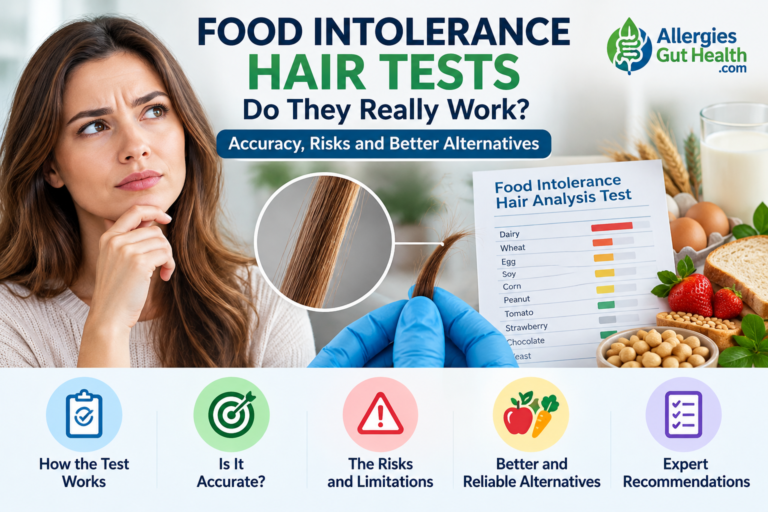
Food intolerance hair tests are not scientifically validated for diagnosing food intolerance or food allergy. Some home kits ask you to mail in a hair sample and promise a long list of foods to avoid. Professional allergy organizations advise against relying on these results. If you have symptoms after eating, a medical history and targeted assessment are more useful than a broad hair-testing report.
What is a food intolerance hair test?
A food intolerance hair test is a commercial service that analyzes a hair sample and claims to identify foods that cause digestive symptoms or other health problems. Providers may use different methods and terminology. A report may label dozens of foods as problematic even if you regularly eat them without symptoms.
Hair testing is not the same as an allergy skin-prick test or a blood test for food-specific IgE antibodies. The latter tests can help an allergist investigate a suspected immediate food allergy when interpreted alongside symptoms.
Do food intolerance hair tests work?
There is no reliable evidence that hair analysis can identify food allergies or intolerances. The Australasian Society of Clinical Immunology and Allergy (ASCIA) lists hair analysis among unproven tests and warns that misleading results can lead to unnecessary dietary restrictions and delayed diagnosis.
Importantly, an impressive-looking laboratory report does not establish that a method accurately diagnoses a medical condition. Ask whether the test has been validated against accepted diagnostic methods for the specific condition it claims to detect.
Food allergy vs food intolerance: why the difference matters
A food allergy involves the immune system and can sometimes cause a severe reaction, including anaphylaxis. Food intolerance often involves difficulty digesting or processing a food. Lactose intolerance, for example, can cause gas, bloating and diarrhea after consuming lactose.
Because the causes differ, there is no single universal test that accurately diagnoses every food-related symptom. Read our food allergy vs food intolerance guide for a clearer comparison.
Are IgG food sensitivity blood tests any better?
Commercial IgG or IgG4 food panels are also not recommended to diagnose food allergies or intolerances. The American Academy of Allergy, Asthma & Immunology (AAAAI) explains that food-specific IgG can reflect exposure to food, rather than a harmful reaction. An elevated result alone is not a reason to eliminate a food.
IgG testing should not be confused with targeted food-specific IgE blood testing used in an appropriate allergy evaluation. Learn about skin tests, IgE blood tests and supervised oral food challenges.
What to do instead of buying a hair test
- Record symptoms and meals. Note what you ate, the amount, when symptoms began and how long they lasted. Include medications and other possible triggers.
- Talk with a qualified clinician. They can check whether symptoms fit food allergy, lactose intolerance, celiac disease, irritable bowel syndrome or another condition.
- Use targeted tests when appropriate. An allergist may recommend skin-prick or specific IgE blood tests for a suspected food allergy; some cases require a medically supervised oral food challenge. Other conditions need different investigations.
- Avoid unnecessary food restrictions. Do not cut out major food groups solely because a commercial panel says they are problematic. A dietitian can help when a structured elimination and reintroduction approach is medically appropriate.
Safety: If eating a food causes trouble breathing, throat tightness, faintness or rapidly worsening symptoms, seek emergency care immediately. Do not try a food challenge at home if an allergy is suspected.
Can a hair test identify lactose intolerance?
No validated hair analysis diagnoses lactose intolerance. Clinicians usually assess the pattern of symptoms and may use a hydrogen breath test or other appropriate methods. See our lactose intolerance vs milk allergy comparison.
Frequently asked questions
Are at-home food intolerance hair tests accurate?
They are not scientifically validated for diagnosing food intolerance or food allergy. A list of foods produced by a hair test should not be treated as a diagnosis.
Can a hair test tell me which foods cause bloating?
No reliable evidence shows that hair analysis can pinpoint the cause of bloating. Bloating has many possible causes, and a clinician can help assess persistent symptoms.
Should I stop eating foods flagged by a hair test?
Do not make major dietary restrictions based on the result alone. Discuss ongoing symptoms and any proposed elimination diet with a qualified clinician or registered dietitian.
What is the best test for food intolerance?
It depends on the suspected condition. There is no single validated test for all food intolerances. Diagnosis may involve a history, targeted testing and a professionally guided dietary trial.
Why hair-testing reports can be misleading
Some providers describe their methods using terms such as bioresonance, energetic analysis, or intolerance screening. These labels do not establish clinical validity. For a diagnostic test to be useful, researchers must show that it measures what it claims to measure and reliably distinguishes people with a condition from people without it.
Results may also be difficult to interpret. If a report flags 20 or 30 everyday foods, a person might conclude that nearly everything they eat is causing harm. But without a validated link between the test result and actual symptoms, such a conclusion is unsupported. A commercial report cannot replace an individualized clinical assessment.
What can happen if you follow an inaccurate test result?
Unnecessary food avoidance
Removing foods based on an unproven report can make eating complicated and expensive. Avoiding dairy, wheat, eggs, or several other staples without a clear reason can reduce dietary variety and, without suitable replacements, may make it harder to meet nutritional needs. This is particularly concerning for children, people who are pregnant, and anyone with an already restricted diet.
Delayed diagnosis
Symptoms blamed on food intolerance can sometimes have other causes. Recurrent abdominal pain, diarrhea, weight loss, anemia, or blood in the stool should not be dismissed because a hair test supplied an answer. Persistent or concerning symptoms deserve medical evaluation.
False reassurance about allergy
A negative hair test does not mean a food is safe for someone with a suspected allergy. Severe allergic reactions are a medical issue, and appropriate assessment is especially important when symptoms include wheezing, swelling, faintness, or repeated vomiting soon after eating.
Comparison: hair tests, IgG panels and medically used tests
| Method | What it claims or measures | Role in diagnosis |
|---|---|---|
| Hair analysis for food intolerance | Claims to identify trigger foods from hair | Not validated to diagnose food intolerance or allergy |
| Food-specific IgG or IgG4 panel | Measures antibodies often associated with food exposure | Not recommended to diagnose food allergy or intolerance |
| Skin-prick allergy test | Looks for sensitization to a suspected allergen | Can support an allergy evaluation, but results alone do not prove clinical allergy |
| Food-specific IgE blood test | Measures IgE antibodies to selected foods | Useful in context when an IgE-mediated allergy is suspected; not a broad intolerance screen |
| Supervised oral food challenge | Observes reactions to a food under medical supervision | Often used to confirm or rule out food allergy when appropriate |
| Hydrogen breath test | Measures breath gases after a test sugar | May help evaluate lactose malabsorption or other specific conditions |
Which test is appropriate depends on the symptoms and medical history. No method in this table is a substitute for a clinician deciding what needs investigation.
How doctors investigate symptoms after eating
1. Start with the pattern
The timing of symptoms is often informative. Hives, swelling, breathing problems, or vomiting soon after a particular food may suggest an immediate allergy. Bloating, gas, or diarrhea hours after a meal may have a different explanation. Neither pattern is enough to diagnose a condition on its own.
2. Consider the most likely causes
A clinician may consider lactose intolerance, celiac disease, food allergy, irritable bowel syndrome, medication effects, or other gastrointestinal disorders. For suspected celiac disease, testing should generally happen before starting a gluten-free diet because removing gluten can affect results.
3. Choose tests for a specific question
For a possible immediate food allergy, a specialist may select particular allergens for skin-prick or IgE blood testing. Testing a large panel of foods without a relevant history can produce positive sensitization results that do not reflect true clinical allergy. A medically supervised oral food challenge may be needed in selected cases.
4. Use dietary trials carefully
For some suspected intolerances, a short, structured elimination and reintroduction process may help clarify whether a food is associated with symptoms. This should be planned with a qualified professional, particularly when multiple foods, a child, or a person with nutritional risks are involved. Do not reintroduce a food at home if there is concern about a serious allergic reaction.
What about hair mineral analysis?
Hair can sometimes be analyzed for specific substances in other contexts, but that does not validate using hair to identify food intolerance. A laboratory’s ability to measure a substance in hair is a separate question from whether its result can accurately diagnose symptoms after eating. Be cautious when a marketing page blurs that distinction.
Questions to ask before paying for a home test
- What exact condition does this test diagnose?
- Has its accuracy been demonstrated in independent clinical studies?
- Which recognized medical guidelines recommend it?
- Will a qualified clinician interpret the results with my history?
- Could acting on the result lead to unnecessary restrictions or missed diagnoses?
If the provider cannot give clear, verifiable answers, consider discussing your symptoms with a clinician before spending money on the kit.
When to seek medical help
Book a medical appointment for recurring symptoms after meals, unexplained weight loss, ongoing diarrhea, difficulty maintaining nutrition, or symptoms that interfere with daily life. Seek urgent emergency care for signs of a severe allergic reaction such as difficulty breathing, throat swelling, collapse, or rapidly progressing symptoms. If you have been prescribed an epinephrine auto-injector, follow your emergency action plan.
Bottom line
Food intolerance hair tests may look convenient, but their results cannot reliably diagnose food-related reactions. A symptom history, condition-specific tests and qualified medical advice offer a safer route to finding the cause.
Medical sources
- ASCIA: Allergy testing and unproven methods
- ASCIA: Food intolerance
- AAAAI: The myth of IgG food panel testing
- AAAAI: Food allergy diagnosis
This article is for general education and is not a personal diagnosis or treatment plan.
